During the 1970s, acid rain was viewed as a serious environmental threat throughout North America and Europe.
The atmosphere was filled with pollution from coal-fired power plants and vehicles. As a result, the rain was toxic.
An article in the 10 March 2025 edition of Vox begins with this headline: We got rid of acid rain. Now something scarier is falling from the sky. Here’s the subhead: “Here’s why you should never, ever drink the rain.”
How bad was the rain during the 1970s? According to the initial paragraph at Vox, “In the 1970s, acid rain was one of the most serious environmental threats in North America and Europe. The air was so laden with pollution from coal power plants and cars at the time that it turned the rain toxic. Downpours killed fish, destroyed forests, eroded statues, and damaged buildings, sparking public outcry.”
Gary Hart is an American politician, diplomat, and lawyer. He was the front-runner for the 1988 Democratic presidential nomination until he dropped out amid rumors of extramarital affairs. According to the article at Vox, Hart was quoted in the New York Times on 7 October 1979: “Acid rain is a particularly alarming demonstration of the simple adage that what goes up must come down. With acid rain, what comes down is much worse than what went up — worse in its potential damage to trees and crops, worse in its potential damage to freshwater lakes and fish and tourism.”
Only a few decades have passed since acid rain was said to pose a serious threat to forest, crops, fish, lakes, and tourism. We hardly ever read or hear about acid rain today. What happened?
During the late 1980s and early 1990s, Europe and the U.S. finally took seriously the threat posed by acid rain. Specifically, legislation was passed that limited acid-forming pollutants from power plants. Sulfur dioxide and nitrogen oxides, the major chemicals responsible for acid rain emitted by power plants, were limited by federal legislation. Vehicle manufacturers were required to install catalytic converters into new automobiles. As a result, acid rain is largely a problem solved by societal actions. Acid rain is a major success story with respect to societal response to an environmental issue.
Taking the usual approach for humans, it’s out of the frying pan, into the fire we go. Acid rain was identified as a significant threat. Legislation was passed to address the threat, thereby solving the problem. The problem we face today is much greater. It cannot be solved with legislation. Thus, the frying pan-fire analogy.
I have mentioned the horrors associated with plastic previously in this space. Specifically, the group of so-called forever chemicals haunt us. Perfluoroalkyl and polyfluoroalkyl substances are the forever chemicals collectively called PFAS. They are included within the large group of compounds used to make nonstick pans and stain-resistant fabric. As suggested by the moniker forever chemicals, they persist seemingly forever in the environment. They are described by the article in Vox: “Over time, these modern-era substances — which famously take decades to millennia to degrade — have leached into the environment, reaching every corner of the planet, no matter how tall or deep. Microplastics, PFAS, and some other compounds, such as pesticides, are now so widespread that they’ve essentially become part of our biome, not unlike bacteria or fungi.
They’re so common, in fact, that they’re even found in the rain.
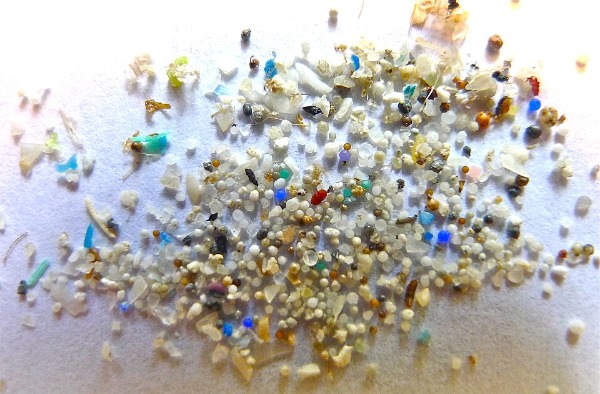
A number of studies, for example, have documented microplastics in rain falling all over the world — even in remote, unpopulated regions. For one 2020 analysis in the journal Science, researchers documented microplastics in rainwater that fell on several national parks and wilderness areas in the Western US. Most of the plastic bits were microfibers, such as those shed from polyester sweaters or carpeting on the floor of a car. The researchers estimated that more than 1,000 metric tons of plastic from the atmosphere fall on parks in the West each year, including both as rainfall and as dry dust. That’s equivalent to roughly 120 to 300 million plastic water bottles, according to the study.
The largest source of those microplastics was highways, said … a biogeochemist at Utah State University who led the Science study. Roads are often littered with plastic waste that gets broken down by cars and kicked up into the air. Those particles are typically lighter than soil, so once they become airborne, they can easily move around in the atmosphere and get grabbed by rain as it falls.”
The biochemist at Utah State University who led the research published in Science provides the bottom line for the article at Vox: “To be honest, I cry, because there’s no walking this back. These particles don’t break down at a time scale that would be relevant. So yeah, we’re not escaping that.”
Just when I believe the situation cannot get worse, I read a little more. I need to stop reading. As the late, great stand-up comic Bill Hicks said, quoting a waitress at a Waffle House in Nashville, Tennessee, “whatcha readin’ for?”
I need to stop reading. Maybe I’ll just switch to a safer genre. Fiction comes to mind.
Author
"Dr. Guy McPherson is an internationally recognized speaker, award-winning scientist, and the world’s leading authority on abrupt climate change leading to near-term human extinction. He is professor emeritus at the University of Arizona, where he taught and conducted research for twenty years. His published works include 14 books and hundreds of scholarly articles. Dr. McPherson has been featured on TV and radio and in several documentary films. He is a blogger, cultural critic, and co-host of his own radio show “Nature Bats Last.” Dr. McPherson speaks to general audiences across the globe, and to scientists, students, educators, and not-for-profit and business leaders who seek their best available options when confronting Earth’s cataclysmic changes." source
Latest Peer-Reviewed Journal Article:
McPherson, Guy R., Beril Sirmack, and Ricardo Vinuesa. March 2022. Environmental thresholds for mass-extinction events. Results in Engineering (2022), doi: https://doi.org/10.1016/j.rineng.2022.100342.