

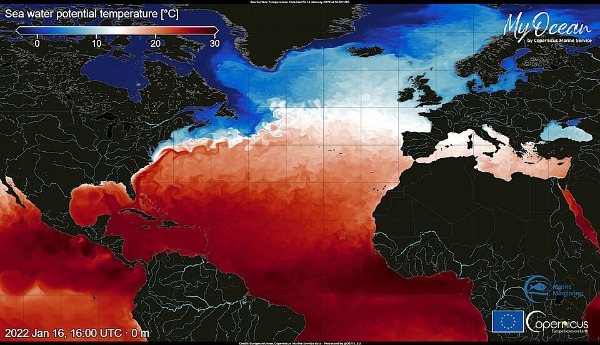
As you probably expect, world oceans are heating. This is an expected response to abrupt, irreversible climate change, as reported by the designed-to-fail Intergovernmental Panel on Climate Change with two reports published more than five years ago.
I have mentioned these two reports many times in this space.
The first of these two reports was published on 8 October 2018. Titled Global Warming of 1.5°, this report cited the peer-reviewed literature in reaching the conclusion that “global-level rates of human-driven change far exceed the rates of change driven by geophysical or biosphere forces that have altered the Earth System trajectory in the past …; even abrupt geophysical events do not approach current rates of human-driven change.”
The second report, published on 24 September 2019, concluded that an overheated ocean was responsible for the irreversibility of climate change. It was titled IPCC Special Report on the Ocean and Cryosphere in a Changing Climate. As with all reports issued by the IPCC, it depended on peer-reviewed literature.
As I have also reported many times in this space, the IPCC is scientifically conservative. Even a scientifically conservative peer-reviewed paper published in March 2019 agreed. The title of a peer-reviewed paper in BioScience created by four scholars and focused on the IPCC: Statistical Language Backs Conservatism in Climate-Change Assessments.
In other words, we have known since 24 September 2019 that an overheated ocean is responsible for irreversible climate change. The IPPC Special Report on the Ocean and Cryosphere in a Changing Climate revealed this finding long ago. In typical scientific fashion, a peer-reviewed paper published 11 March 2025 has reached the same conclusion. Reconciling Earth’s growing energy imbalance with ocean warming was published on that date in the peer-reviewed, open-access Environmental Research Letters.
Created by two scholars, this peer-reviewed paper includes this information in the Abstract: “Rising greenhouse gas concentrations and declining global aerosol emissions are causing energy to accumulate in Earth’s climate system at an increasing rate. Incomplete understanding of increases in Earth’s energy imbalance and ocean warming reduces the capability to accurately prepare for near term climate change and associated impacts. … the large observed near-global ocean surface warming of 0.27 °C from 2022 to 2023 is found to be physically consistent with the large energy imbalance of 1.85±0.2 Wm−2 from August 2022 to July 2023 but only if (1) a reduced depth of the mixed layer is experiencing the heating or (2) there is a reversal in the direction of heat flux beneath the mixed layer associated with the transition from La Niña to El Niño conditions. This new interpretation of the drivers of Earth’s energy budget changes and their links to ocean warming can improve confidence in near term warming and climate projections.”
The Introduction of the peer-reviewed paper cites many additional peer-reviewed papers while subtly mentioning the aerosol masking effect: “Rising greenhouse gases have driven an imbalance between sunlight absorbed by the planet and infrared radiative emission to space, leading to an accumulation of energy and warming climate ... The planetary heating rate has grown since the 1970s …, indicating an acceleration of climate change ... This global net energy imbalance has continued to increase since 2000 based on satellite and ocean data, mostly due to a reduction in reflected sunlight … that is linked to cloud and aerosol changes as well as reduced sea ice coverage ... Determining the extent to which energy budget changes are driven by aerosol cloud-microphysical effects, indirect effects of radiative forcings on atmospheric stability and circulation, cloud feedbacks to sea surface temperature … patterns or internal climate variability are vital for near term predictions ... Record levels of the net imbalance and global surface temperatures in 2023 … accentuate the need to advance understanding of linkages between Earth’s energy imbalance, ocean heating and surface warming ...”
The Introduction continues by describing the goal of this paper: “reanalysis data is combined with satellite observations to assess the spatial signal of the growing energy imbalance and to develop a conceptual picture of how it is driving ocean heating since 1985, up to the most recent record warming of the 2023/24 El Niño event. Details of the datasets are introduced within the narrative of the paper, which first outlines global changes in Earth’s energy budget …, investigates the spatial structure of changes …, develops a simple energy budget approach to understand ocean warming … and discusses the role of energy budget changes in explaining the unprecedented levels of Earth’s net energy imbalance and ocean surface temperature in 2023 ...”
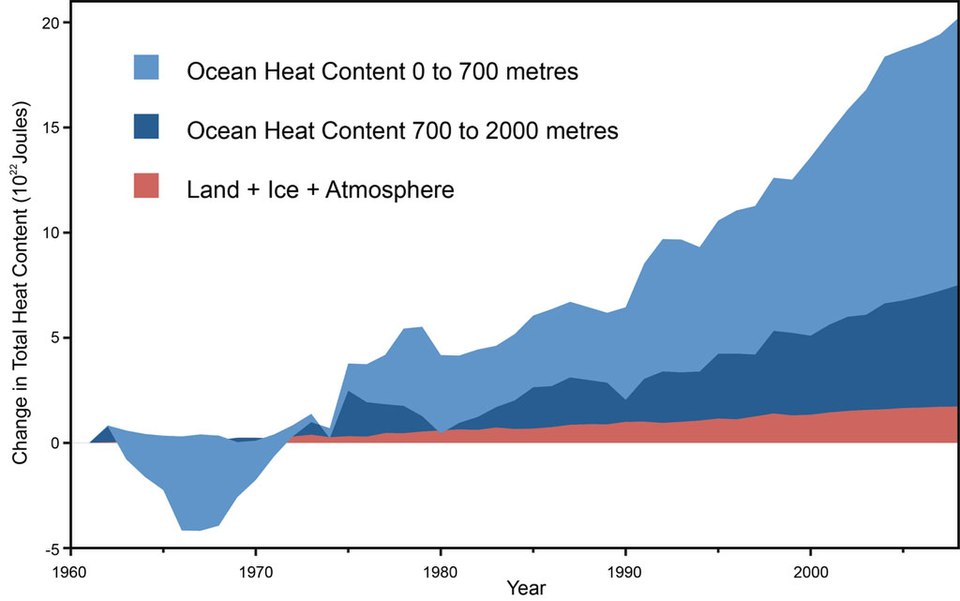
The Conclusions section provides a good overview of the findings of this research within the context of peer-reviewed literature: “We find a growth in the Earth’s rate of heating, from 0.6±0.2 Wm−2 in 2001–2014 to 1.2±0.2 Wm−2 in 2015–2023, is dominated by increases in absorbed sunlight over the ocean and is associated with cloud effects. This increasing energy imbalance is coincident with a divergence in the amount of sunlight absorbed by the planet between CERES satellite observations and the ERA5 reanalysis after 2014. Spatial differences between ERA5 and the satellite data have allowed us to attribute the growing imbalance to increases in absorbed sunlight over most ocean regions, with the largest changes over the Californian and Namibian stratocumulus cloud decks. These new results extend our understanding of how the growth in Earth’s energy imbalance has manifested regionally and are dominated by the cloudy ocean. The observed heating is further reconciled with rising global temperatures, up to the record levels experienced in 2023 …”
I’ll read the first half of that first sentence again: “We find a growth in the Earth’s rate of heating, from 0.6±0.2 Wm−2 in 2001–2014 to 1.2±0.2 Wm−2 in 2015–2023 …” Earth’s rate of heating doubled between 2001-2014 and 2015-2023. This doubling of Earth’s rate of heating within a short period of time is an enormous finding. Five paragraphs later, we find even worse news: “Based on observational evidence and assumptions, we determine an ocean heating of ∼1.49±0.33 Wm−2 during the rapid warming period, August 2022 to July 2023.” Not only has Earth’s rate of heating doubled between 2001-2014 and 2015-2023, but it has continued to increase very rapidly. Within the one-year period from August 2022 to July 2023, the ocean heated ∼1.49±0.33 Wm−2. This is an astonishing rate of increase within a single year.
In other words, we continue to overheat an already overheated planet. Apparently, we’re willing to let go of habitat for human animals to make sure a few people are comfortable. Apparently, that’s what we consider normal.
Author
"Dr. Guy McPherson is an internationally recognized speaker, award-winning scientist, and the world’s leading authority on abrupt climate change leading to near-term human extinction. He is professor emeritus at the University of Arizona, where he taught and conducted research for twenty years. His published works include 14 books and hundreds of scholarly articles. Dr. McPherson has been featured on TV and radio and in several documentary films. He is a blogger, cultural critic, and co-host of his own radio show “Nature Bats Last.” Dr. McPherson speaks to general audiences across the globe, and to scientists, students, educators, and not-for-profit and business leaders who seek their best available options when confronting Earth’s cataclysmic changes." source
Latest Peer-Reviewed Journal Article:
McPherson, Guy R., Beril Sirmack, and Ricardo Vinuesa. March 2022. Environmental thresholds for mass-extinction events. Results in Engineering (2022), doi: https://doi.org/10.1016/j.rineng.2022.100342.