

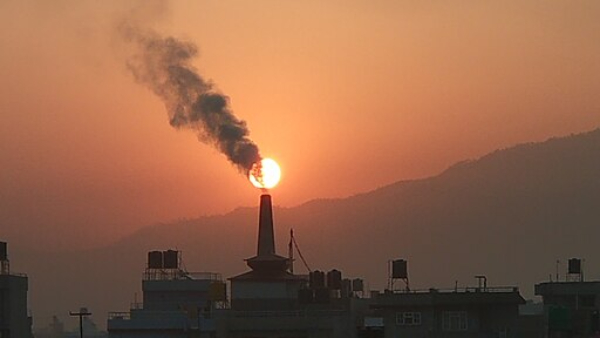
As you probably know, there is an advantage to air pollution.
This air pollution blocks incoming sunlight, thereby preventing the energy from warming Earth.
James E. Hansen refers to the aerosol masking effect as our Faustian Bargain. I’ve been calling it the best-keep secret in climate science since I discovered it, based on a peer-reviewed paper by Hansen and colleagues.
An article at Phys.Org is titled Air pollution cuts in East Asia likely accelerated global warming. Published on 14 July 2025, the article includes a link to a peer-reviewed paper, as indicated in the lede: “The cleanup of air pollution in East Asia has accelerated global warming, a new study … in the journal Communications Earth and Environment has found.”
Also published on 14 July 2025, the peer-reviewed, open-access paper is titled East Asian aerosol cleanup has likely contributed to the recent acceleration in global warming. Based on this title, the advantage of reducing air pollution doesn’t seem like such a great idea. The paper was written by 24 scholars and is part of the renowned Nature series of peer-reviewed publications.
The two paragraphs after the lede at Phys.Org provide a story with which you are probably familiar: “Global warming, driven primarily by emissions of greenhouse gases, has been accelerating for the past 15 years, leading to record-breaking surface temperatures. Over the same period, countries in East Asia have made strong efforts to clean up air pollution, which is important for public health. The largest air pollution clean-up has been made in China, where ambient air pollution is responsible for about 1 million deaths a year.
But air pollution has also helped cool the climate. Sulfate aerosols, arising from burning fossil fuels, can shade Earth's surface from sunlight. Air pollution has therefore inadvertently held in check some greenhouse gas driven warming.”
Reducing air pollution doesn’t seem like such a great idea when it produces additional warming on an overheated planet. One of the authors of the peer-reviewed paper is a Professor at the University of Reading. She provided this explanation at Phys.Org: “The climate effects of air pollution are short-lived, while the impact of carbon dioxide emissions can be felt for centuries. This means that the acceleration of warming due to reductions in air pollution is also likely to be short-lived. We will see an acceleration of warming while the unmasking takes place, and then a return to a greenhouse-gas driven rate of warming as air pollution stabilizes.”
I think that’s small consolation. After all, saying the “climate effects of air pollution are short-lived” seems short-sighted. Any additional heating on an overheated Earth is a terrible idea.
The first author of the peer-reviewed paper is a senior researcher at CICERO Center for International Climate Research. This institution is an interdisciplinary research centre for climate research and environmental science. According to its website, it is Norway’s foremost institute for interdisciplinary climate research. Upon release of the peer-reviewed paper, its first author was quoted in the Phys.Org article: “We have been able to single out the climate effects of air quality policies in East Asia over the last 15 years. Our main result is that the East Asian aerosol cleanup has likely driven much of the recent global warming acceleration, and also warming trends in the Pacific.”
I now turn to the peer-reviewed, open-access paper. The Abstract provides a good overview of the research and its findings while quoting other peer-reviewed research: “Global surface warming has accelerated since around 2010, relative to the preceding half century. This has coincided with East Asian efforts to reduce air pollution through restricted atmospheric aerosol and precursor emissions. A direct link between the two has, however, not yet been established. Here we show, using a large set of simulations from eight Earth System Models, how a time-evolving 75% reduction in East Asian sulfate emissions partially unmasks greenhouse gas-driven warming and influences the spatial pattern of surface temperature change. We find a rapidly evolving global, annual mean warming of 0.07 ± 0.05 °C, sufficient to be a main driver of the uptick in global warming rate since 2010. We also find North-Pacific warming and a top-of-atmosphere radiative imbalance that are qualitatively consistent with recent observations. East Asian aerosol cleanup is thus likely a key contributor to recent global warming acceleration and to Pacific warming trends.”
Those of us in the Western world must appreciate that final line: “East Asian aerosol cleanup is thus likely a key contributor to recent global warming acceleration and to Pacific warming trends.” Blaming others for our global-scale problems is a classic approach in the country of my birth.
An Introduction section follows the Abstract. Its second and third paragraphs cite additional peer-reviewed literature in describing the recent acceleration of Earth’s warming: “Concurrently, the rate of global mean surface warming, which has overall been constant at around 0.18 °C/decade since around 1970, has increased. Recent studies find an acceleration in the rate of surface warming and ocean heat uptake after 1990, and the most recent decade (2013–2022) had a warming rate of 0.25 °C/decade, even after reducing the influence of internal variability. 2023 and 2024 were both record-setting in terms of surface temperature anomaly, dominated by strong positive sea-surface temperature anomalies in most ocean basins.”
The initial sentence in the following paragraph provides the rationale for the research described in the peer-reviewed paper: “However, few studies have to date quantified the influence of the recent emissions reductions in East Asia on global and regional climate evolution, despite their being larger in magnitude than the shipping emission changes, and sustained for long (~9 Tg/year since 2020).” A teragram is one trillion grams.
Two paragraphs in the Discussion section provide the bottom line: “The emission reductions in our simulations correspond closely to the emissions reductions realized in East Asia over the period 2010–2023, in magnitude and geographical location. This allows us to put our results in the context of the recent uptick in the observed rate of global mean surface warming. Here, we find that emissions reductions in East Asia have contributed up to 0.05 °C/decade since 2010, explaining a large fraction of the observed increase of 0.06 °C/decade over the same period, after filtering out the effects of interannual variability.
We also find that the geographical location of the temperature influence of a reduction in East Asian … [silicon dioxide] emissions corresponds to where observations show a recent surge in warming, and also where satellite observations find an increase in … [top-of-atmosphere] radiative imbalance. This lends support to the conclusion that the recent intensive effort to tackle air pollution in China has driven, as an unintended side effect, an unmasking of greenhouse gas-driven global warming and a marked contribution to the recently observed warming trend.”
Air pollution is a big deal, as I have mentioned in this space. More than eight million people on Earth die each year from air pollution. I’m not claiming otherwise.
I’ve mentioned the aerosol masking effect many times in this space. This update from a renowned peer-reviewed publisher provides decent justification. It also excuses the masses for not taking individual blame for an overheated planet. It’s not your fault. I am unwilling to blame China for their ongoing efforts to reduce pollution. I’m also unwilling to take the blame for a long-running, world-scale disaster.
Author
"Dr. Guy McPherson is an internationally recognized speaker, award-winning scientist, and the world’s leading authority on abrupt climate change leading to near-term human extinction. He is professor emeritus at the University of Arizona, where he taught and conducted research for twenty years. His published works include 14 books and hundreds of scholarly articles. Dr. McPherson has been featured on TV and radio and in several documentary films. He is a blogger, cultural critic, and co-host of his own radio show “Nature Bats Last.” Dr. McPherson speaks to general audiences across the globe, and to scientists, students, educators, and not-for-profit and business leaders who seek their best available options when confronting Earth’s cataclysmic changes." source