

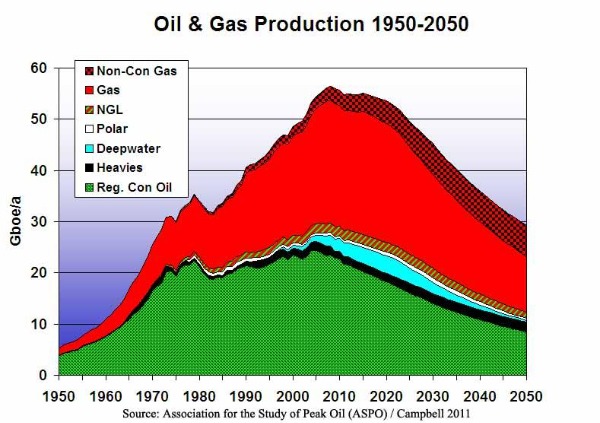
If you have followed guymcpherson.com for long, you will know that I have tracked peak oil for a long time.
There are about 200 posts at this blog on this subject, dating back to the first few posts. The concept remains important, as I stated in mid-May 2023 with a post titled “Science Snippets: Global Peak Oil Remains an Existential Threat.”
According to a report published by the International Energy Agency, global peak oil still matters. In a report published 16 September 2025, the IEA is still ringing the alarm about peak oil. The report is titled Dec>lines in output from existing oil and gas fields have gathered speed, with implications for markets and energy security. The subhead reads: “Without continued investment in these fields, the world would lose the equivalent of Brazil and Norway’s combined production from the global oil balance each year.”
Here’s the lede: “The average rate at which oil and gas fields’ output declines over time has significantly accelerated globally, largely due to higher reliance on shale and deep offshore resources, meaning that companies must work much harder than before just to maintain production at today’s levels, according to a new IEA report.” An embedded report published September 2025 is titled The Implications of Oil and Gas Field Decline Rates.
The embedded report from the International Energy Agency begins with a section titled “About this report.” It contains three short paragraphs: “Much attention today focuses on uncertainties affecting the future evolution of oil and natural gas demand, with less consideration given to how the supply picture could develop. However, understanding decline rates – the annual rate at which production declines from existing oil and gas fields – is crucial for assessing the outlook for oil and gas supply and, by extension, for market balances.
The International Energy Agency … has long examined this issue, and a detailed understanding of decline rates is at the heart of IEA modelling and analysis, underpinning the insights provided by the scenarios in the World Energy Outlook.
This new report – based on analysis of the production records of around 15 000 oil and gas fields around the world – explores the implications of accelerating decline rates, growing reliance on unconventional resources, and evolving project development patterns for the global oil and gas supply landscape, for energy security and for investment. It also provides regional insights.”
The Executive Summary of the report titled The Implications of Oil and Gas Field Decline Rates opens with a subsection titled “Discussions on the future of oil and gas often overemphasise demand drivers and underappreciate supply drivers.” It includes two descriptive paragraphs: “Debate over the future of oil and natural gas tends to focus on the outlook for demand, with much less consideration given to how the supply picture could develop. This asymmetry is misplaced and a thorough understanding of the rate at which production from existing oil and gas fields declines over time is more important than ever. The International Energy Agency … has long examined this issue. Decline rates – the annual rate at which production declines from an existing oil or gas field – underpin our analysis of market balances and investment needs across all outlook scenarios.
Nearly 90% of annual upstream oil and gas investment since 2019 has been dedicated to offsetting production declines rather than to meet demand growth. Investment in 2025 is set to be around USD 570 billion, and if this persists, modest production growth could continue in the future. But a relatively small drop in upstream investment can mean the difference between oil and gas supply growth and static production. At the same time, less investment is required in a scenario in which demand contracts.”
The next subsection is titled “A detailed look at today’s global supply picture.” It, too, is comprised of two descriptive paragraphs: “The composition of oil and gas production has changed rapidly in recent years with the notable rise of tight oil and shale gas. In 2000, conventional oil fields contributed 97% of total oil output globally, however, by 2024 this share had fallen to 77% as a result of rising output from unconventional fields. In the case of natural gas, around 70% of the 4 300 billion cubic metres … produced today is from conventional fields, with nearly all of the rest being shale gas produced in the United States. Even with the shale revolution, overall oil and gas output still relies heavily on a small number of supergiant fields, largely in the Middle East, Eurasia and North America, which together accounted for almost half of global oil and gas production in 2024.
Detailed analysis of the production records of around 15 000 oil and gas fields from around the world reveals that the global average annual observed post‑peak decline rate is 5.6% for conventional oil and 6.8% for conventional natural gas. This varies widely by field type: supergiant oil fields decline by an average of 2.7% annually, while the average for small fields is more than 11.6%. Onshore oil fields decline more slowly, by an average of 4.2% per year, than those located deep offshore at 10.3%. The Middle East, which holds the world’s largest conventional onshore fields, has the lowest oil observed post-peak decline rate at 1.8%, while Europe, which is has a very high share of offshore fields, exhibits the highest decline rate at 9.7%.”
These latter two paragraphs contain a lot of numbers, which can be daunting. I will attempt to summarize without losing significant information. Let’s take a look at this sentence: “In 2000, conventional oil fields contributed 97% of total oil output globally, however, by 2024 this share had fallen to 77% as a result of rising output from unconventional fields.” A decline from 97% in 2000 to 77% in 2024 represents more than 20% decrease in oil availability. Meanwhile, the human population has grown from about 6.2 billion people in 2000 to about 8.1 billion people in 2024. That’s more than a 30% increase in humans while oil availability has declined more than 20%.
As I have indicated repeatedly at guymcpherson dot com, oil is the master material. Without oil, we cannot extract other fossil fuels. We cannot transport materials crucial to our survival and comfort. Without oil, this set of living arrangements disappears. Due to the rapid rate of environmental change in our wake, life on Earth ceases to exist. Even if you’re not a fan of civilization, you’re probably a fan of life ... even if it’s only your own.
Author
"Dr. Guy McPherson is an internationally recognized speaker, award-winning scientist, and the world’s leading authority on abrupt climate change leading to near-term human extinction. He is professor emeritus at the University of Arizona, where he taught and conducted research for twenty years. His published works include 14 books and hundreds of scholarly articles. Dr. McPherson has been featured on TV and radio and in several documentary films. He is a blogger, cultural critic, and co-host of his own radio show “Nature Bats Last.” Dr. McPherson speaks to general audiences across the globe, and to scientists, students, educators, and not-for-profit and business leaders who seek their best available options when confronting Earth’s cataclysmic changes." source