
As I have reported many times in this space, corporate media outlets have rarely reported the collapse of civilization.
This set of living arrangements, like all its predecessors, will cease to exist at some point. Identifying the timing and rapidity of collapse is difficult, of course. However, many have tried, including me. Like most others, I have failed. Unlike most others, I understand the importance of making predictions as a part of the process of acquiring reliable knowledge.
The signature line of an article in The Guardian quotes Dr. Luke Kemp at the Centre for the Study of Existential Risk at the University of Cambridge. After correctly pointing out that Industrial Civilization teeters on the brink, he said “today’s global civilization … is deeply interconnected and unequal and could lead to the worst societal collapse yet.” Among the solutions he proposed to avoid a global collapse is “Don’t be a dick.” I quote Kemp directly, with apologies to all the people in the world who have shortened their first name from Richard to Dick. Also, I changed the name of this video in response to YouTube not allowing it to be shown with a word that rhymes with stick.
Dr. Kemp obviously doesn’t realize that the collapse of Industrial Civilization is already underway. According to the designed-to-fail Intergovernmental Panel on Climate Change, relying as always on peer-reviewed evidence: “These global-level rates of human-driven change far exceed the rates of change driven by geophysical or biosphere forces that have altered the Earth System trajectory in the past …; even abrupt geophysical events do not approach the current rates of human-driven change.” In other words, Dr. Kemp is following the path of most paid climate scientists, government officials, and corporate media outlets by ignoring the IPCC’s 8 October 2018 Global Warming of 1.5°. This report, published more than seven years ago, continues to be ignored by everyone charged with informing the masses.
Back to that article in The Guardian, which was published 2 August 2025 and titled ‘Self-termination is most likely’: the history and future of societal collapse. The subtitle: “An epic analysis of 5,000 years of civilization argues that a global collapse is coming unless inequality is vanquished.” In other words, the article ignores the abundant evidence for an ongoing collapse of civilization, and it also ignores the horrific inequality already present on Earth. A set of living arrangements dominated by billionaires who ignore or exploit the rapidly vanishing middle class cannot persist indefinitely. Likewise, a set of living arrangements dominated by privilege in the Global North at the expense of the Global South cannot last indefinitely. I am joined by several other informed scholars who have expressed surprise that Industrial Civilization continues to persist, even with rampant, ongoing inequality.
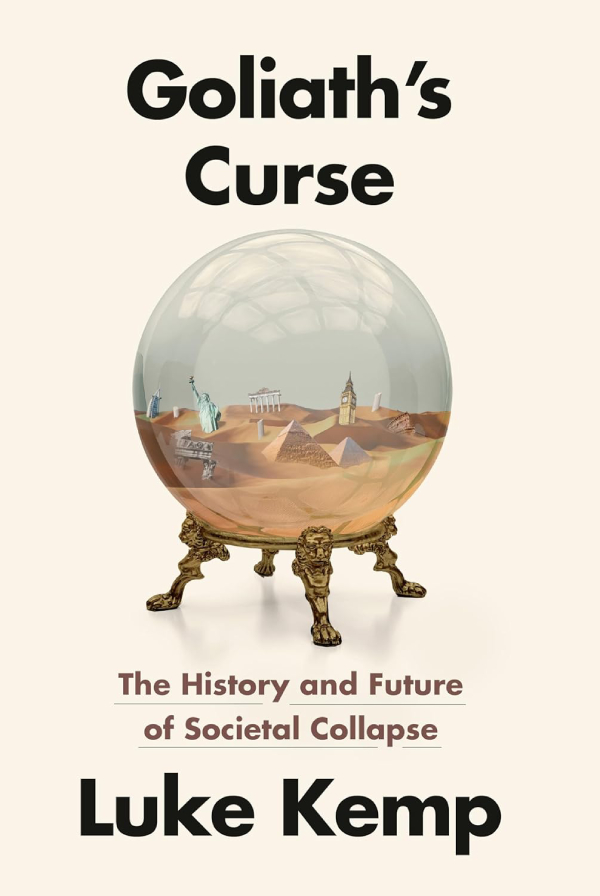
Kemp refuses to use the word civilization to describe this set of living arrangement. Instead, he uses the word Goliaths. As he said, quoted by The Guardian, “When you look at the near east, China, Mesoamerica or the Andes, where the first kingdoms and empires arose, you don’t see civilised conduct, you see war, patriarchy and human sacrifice. Instead, we started to resemble the hierarchies of chimpanzees and the harems of gorillas.” From this perspective, the progress of civilization, as pointed out by The Guardian, “was a form of evolutionary backsliding from the egalitarian and mobile hunter-gatherer societies which shared tools and culture widely and survived for hundreds of thousands of years.” Anyone paying the slightest bit of attention realizes that this set of living arrangements benefits the few at the expense of the many.
Kemp argues that civilizations arise when societies have access to three primary elements. They need grain, as I have pointed out many times in this space. Grains can be stored for a long time compared to other types of food. The second element needed to dominate other societies is weaponry. For example, bronze swords and axes were far superior to stone and wooden axes. Dominant weaponry continues to ensure dominance of one group over others. A quick glance at military dominance by the country of my birth compared to other societies offers a convincing example. The third element identified by Kemp is locations where oceans, rivers, deserts, and mountains keep people from migrating away from rising tyrants. As Kemp points out in The Guardian article: “History is best told as a story of organised crime. It is of one group creating a monopoly on resources through the use of violence over a certain territory and population.”
Kemp points out that every society contains the seeds of their own demise: “They are cursed … because of inequality.” Kemp correctly blames those near or at the top of the privileged class for societal collapse: “… as elites extract more wealth from the people and the land, they make societies more fragile, leading to infighting, corruption, immiseration of the masses, less healthy people, overexpansion, environmental degradation and poor decision making by a small oligarchy. The hollowed-out shell of a society is eventually cracked asunder by shocks such as disease, war or climate change.”
The Guardian article points out that increasing wealth inequality consistently precedes collapse. Taking a stunningly optimistic view, Kemp indicated that survivors of early collapsed civilizations had better lives because of the collapse. Liberation from domination and taxation allowed the return to farming. Kemp said, “After the fall of Rome, people actually got taller and healthier.”
Instead of continuing down this ridiculous path of disaster leading to better lives, Kemp correctly points out that “we have one single, interconnected global … [civilization]. All our societies act within one single global economic system – capitalism.” He cites three reasons the collapse of contemporary civilization would be far worse than previous events. First, collapses are accompanied by violence. Outcomes associated with swords and muskets pale in comparison to those resulting from nuclear weapons. Second, collapses in the past meant a return to hunting, gathering, and growing food. Contemporary global society is characterized by people living specialized lives. If global infrastructure fails, the tasks associated with specialization will disappear. Finally, Kemp points out that “all the threats we face today are far worse than in the past.” In addition to nuclear weapons, he cites climate change, artificial intelligence, killer robots, and pandemics. Each of these disasters will have worse outcomes than they did in the past.
The bottom line comes in the final three paragraphs of The Guardian article, which heavily quotes Kemp: “Collapse isn’t just caused by structures, but also people. If you want to save the world then the first step is to stop destroying it. In other words: don’t be a dick. Don’t work for big tech, arms manufacturers or the fossil fuel industry. Don’t accept relationships based on domination and share power whenever you can.”
Kemp’s pessimism shows when he is asked about the possibility of avoiding collapse. Never mind that collapse is already under way. With respect to avoiding collapse, Kemp said “I think it’s unlikely. We’re dealing with a 5,000-year process that is going to be incredibly difficult to reverse, as we have increasing levels of inequality and of elite capture of our politics.
But even if you don’t have hope, it doesn’t really matter. This is about defiance. It’s about doing the right thing, fighting for democracy and for people to not be exploited. And even if we fail, at the very least, we didn’t contribute to the problem.”
That’s a stunningly optimistic perspective. Claiming that defiance is useful is a prescription for doing time behind bars. Is that how you want to spend your final years?
Author
"Dr. Guy McPherson is an internationally recognized speaker, award-winning scientist, and the world’s leading authority on abrupt climate change leading to near-term human extinction. He is professor emeritus at the University of Arizona, where he taught and conducted research for twenty years. His published works include 14 books and hundreds of scholarly articles. Dr. McPherson has been featured on TV and radio and in several documentary films. He is a blogger, cultural critic, and co-host of his own radio show “Nature Bats Last.” Dr. McPherson speaks to general audiences across the globe, and to scientists, students, educators, and not-for-profit and business leaders who seek their best available options when confronting Earth’s cataclysmic changes." source