
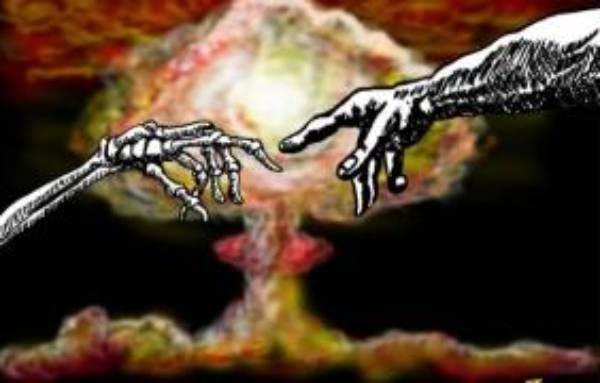
I thought of my grandchildren, I thought of the children of Hiroshima, carbonized in an instant, while they played in the schoolyards...
Dawn breaks in Havana with that hazy sunlight that heralds a storm. I turn on the battery-powered radio while I prepare my morning coffee —a habit acquired during the blackouts— and the news lingers like a bad omen: the Doomsday Clock has been set at 85 seconds to midnight.
I stand for a few moments with the spoon in the air, suspended between the cup and the sugar. Eighty-five seconds, that is to say, nothing, barely a sigh, the time it takes a religious person to cross themselves before crossing the street.
But then I have my coffee, skim the rest of the newspaper, and go on with my routine. Life goes on, and there, in that very human gesture of normalizing what should terrify us, lies the true danger of our era.
We live surrounded by threats without batting an eye, while the great powers dangerously lower the threshold of nuclear deterrence.
As I write these lines, the United States and Israel are preparing to attack Iranian nuclear facilities without the international community managing to issue a firm condemnation.
The extraordinary thing about all this is not that it's happening, but that we receive it with the same excitement with which we check the weather forecast or read the baseball or soccer scores.
Thus, bureaucratic coldness, that administrative language of the elites who govern the planet, applied to the end of the world, is perhaps the most unequivocal symptom of our time.
The fear industry, meanwhile, is having a field day. The construction of private shelters has skyrocketed by 200% since 2022, and luxury bunkers, equipped with radiation showers, concrete and steel walls, and potable water tanks to last for months, are proliferating like mushrooms.
The cost of these modern-day Noah's Arks ranges from €150,000 to €350,000 in Europe; scientists, however, are quick to debunk the fantasy. Brooke Buddemeier, from the Lawrence Livermore National Laboratory, points out that, after a nuclear explosion, a person has barely 15 minutes to seek shelter from radioactive fallout.
The reality is that underground bunkers will not protect people. We must invest in preventing nuclear proliferation; however, people prefer to believe in individual salvation rather than collective responsibility. We have become a society of idiots who stockpile canned goods, while arsenals grow and treaties expire.
The survivor's lie
There's a scene that encapsulates this ideological poisoning better than any academic essay: in the Netflix series The Shelter, a group of billionaires barricades themselves in a luxurious bunker to survive a nuclear holocaust. The premise is appealing, cinematically flawless: money buys immortality, at least for a few episodes.
But reality is far less photogenic. Experts agree that even if someone were to find shelter in time, the so-called "nuclear winter" would collapse global agriculture and condemn survivors to famine, epidemics, and extreme violence.
Meanwhile, the Western press has been instilling the dangerous idea that nuclear war is just another form of conflict, an additional step in the escalation of warfare, like someone going from a machete to a rifle, and from a rifle to a missile.
This "normalization" of the apocalypse is, perhaps, the most perverse triumph of the arms industry: making total destruction seem, quite simply, inevitable.
Some years ago, the Japanese filmmaker Ryusuke Hamaguchi released a film that had nothing to do with atomic war, but which, at its core, spoke of the same thing: how wounds don't heal if they aren't named, how silence rots the soul.
Perhaps something similar is happening to us with the nuclear threat; we have been so silent, so accustomed to its invisible presence, that we no longer even perceive it.
The morning I was correcting these lines, I looked out onto the balcony. The neighborhood was calm, a brown dog was nodding lazily on the sidewalk, and the sky was beginning to turn that deep blue that precedes dawn.
I thought of my grandchildren, I thought of the children of Hiroshima, carbonized in an instant while playing in the schoolyards, I remembered the phrase Albert Camus wrote the day after that first explosion: "Technical civilization has just reached its highest degree of savagery."
Many years have passed, but the clock keeps ticking, undisturbed, while we drink coffee and leaf through the newspaper, as if nothing were happening.