
Every step is predictable when you follow a narrow path leading to the Seneca Cliff
The thing that hath been, it is that which shall be; and that which is done is that which shall be done: and there is no new thing under the sun. Ecclesiastes 1:9
You read about Trump wanting to increase the US military budget to $1.5 trillion per year, a rise of more than 40% over the current budget of about $1 trillion. Is it madness? Or is it an unavoidable step along the narrow path leading to collapse?
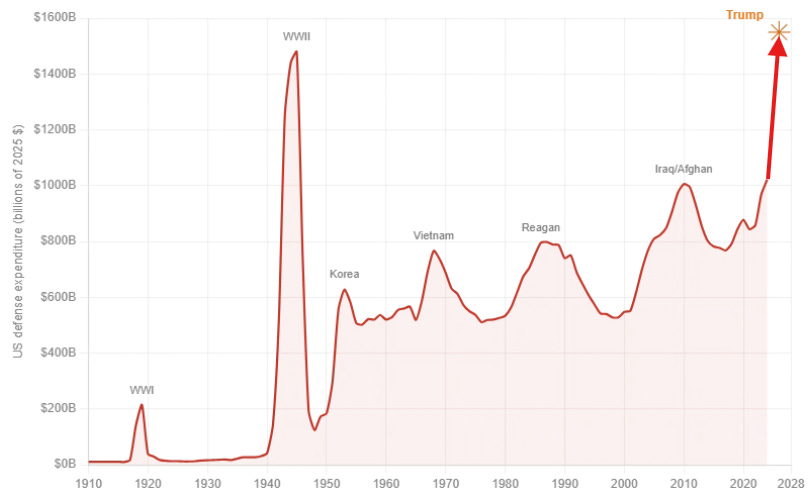
There is a reason for everything, even for the current Western military build-up. Empires are thermodynamic machines: they need energy to function. In this sense, things didn’t change so much from the time of the Roman Empire.

The left diagram was created by Magne Myrtveit to illustrate the structure of the model of modern society created by the “Limits to Growth” 1972 study. On the right, you see a similar diagram I created for the ancient Roman society. The elements of the two diagrams map onto each other.
In both cases, the crucial element is the energy supply. For the modern West, energy comes mainly from fossil fuels. In the Roman case, energy was generated indirectly from precious metal mining; silver, and gold. The mechanism worked by using silver to pay soldiers who would plunder neighboring regions, generating energy in the form of slaves. Slaves would then be used to mine more precious metals, and the process would feed on itself, generating an enhancing feedback. Gold went through the same cycle, although it was more an element of prestige among the elites.
The problem the Romans faced was that mineral precious metals were not infinite, and they progressively became scarcer and more expensive to mine. The Greenland ice-core record tells the story with brutal clarity: lead deposition — the unavoidable byproduct of silver smelting — peaks in the late Republic and falls steadily afterward.
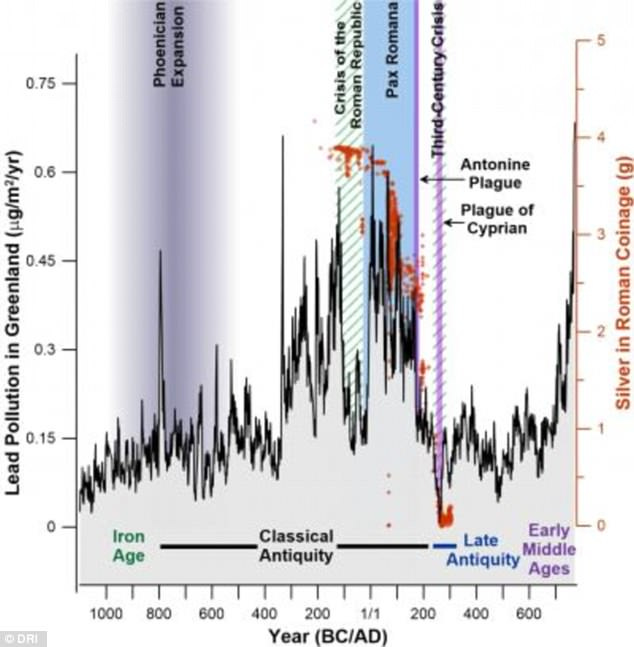
The denarius debasement curve through the third century maps almost perfectly onto the depletion curve of the empire’s mineral anchor.
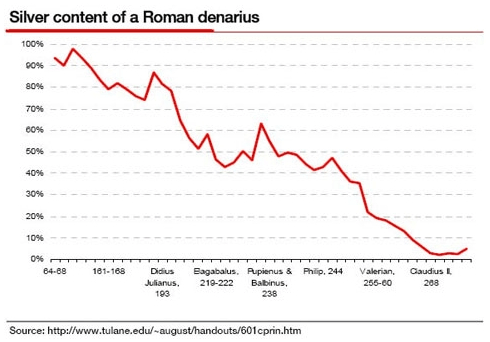
By the time Diocletian issued his price edict in 301 AD, the system had simply lost its energetic foundation. No silver — no legions. No legions — no slaves. No slaves — no silver. The declining feedback loop led the empire to its demise.
Unlike fossil fuels, silver and gold were not burned, but they disappeared from the economy. They were buried as hoards in times of trouble, lost to wear, or shipped East in exchange for luxury goods that then faded into obsolescence. And without wealth and energy, the Roman Empire could not survive.
The lesson for us is how the late Roman state responded to the energy crisis. Diocletian’s reforms (c. 284–305 CE) transformed the Empire into a military dictatorship known as the Dominate. It was a huge bureaucratic structure dedicated to absorbing any surplus of the Roman economy and turning it into troops and weapons.
Among other things, Diocletian created the fabricae armorum— state-run weapon factories. Around 35–40 of them were built across the empire; they are listed in detail in the Notitia Dignitatum. They were separated from civilian production, staffed by hereditary workers who could not legally leave their trade, and directly subsidized by the imperial treasury. This is the institutional signature of a late-imperial military economy: the civilian economy can no longer sustain military production organically, so the state has to manufacture weapons directly.
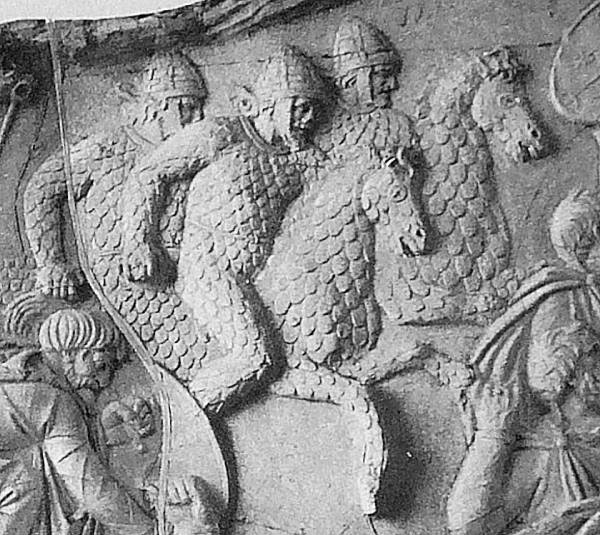
The Roman Fabricae were successful in developing sophisticated weaponry. In the Res Gestae (Book 16.10.8), Ammianus Marcellinus describes the Roman heavy cavalry of the 4th century AD, the Clibanarii, as:
“...cavalry with cuirasses (cataphracti equites), whom they call clibanarii, masked, protected by coverings of iron breast-plates, and girdled with belts of iron, so that you would fancy them statues polished by the hand of Praxiteles, rather than men. And the light circular plates of iron which surrounded their bodies, and covered all their limbs, were so well fitted to all their motions, that in whatever direction they had occasion to move, the joints of their iron clothing adapted themselves equally to any position.”
And yet, despite these super-weapons, the Roman Empire ultimately failed. It was because a purely military economy does not create wealth; it destroys it. The Roman army could win battles up to the last years of the Empire, but every victory made the Empire a little poorer and closer to collapse. An army that’s not sustained by a healthy economic system is a doomed army. And an economic system that wastes its resources in military expenses is a doomed economic system.
Fast forward to our times. War is now an industrial process that needs the output of a whole industrial system; it is the definition of “war of attrition.” No matter who wins in Iran and in Ukraine, the lesson is: spend more on the military industry. That explains Trump’s request to increase the US military budget, and tells us that the “consumer economy” is by now completely obsolete in the West, just as it was at the time of Emperor Diocletian.
The West today is recreating the Roman fabricae armorum without realizing it. Lockheed Martin, Raytheon, BAE — these are state-dependent manufacturers, separated from civilian production, sustained by direct government procurement. We are rebuilding the dictatorial structure of late Rome, complete with hereditary workers (try leaving a security-cleared defense job for civilian life), state subsidy, and separation from the general economy, which is rapidly tanking.
We are also repeating the ancient Roman pattern in terms of seeking more sophisticated (and ultimately useless) weapons. The US F-35 is possibly the most advanced existing fighter plane, the equivalent of the Roman clibanarii. The problem is that a single F-35 is roughly 2000 to 6,000 times more expensive than one Iranian Shahed drone. To say nothing of the cost of an aircraft carrier necessary to bring the F-35 to the operational area. There are more examples of hyper-expensive weapon systems in modern times that were net losses for the societies that produced them. Think of the German Maus superheavy tank of WWII. Or the recent Russian Armata tank. This is not a game that can be won by building more expensive weapons. The Romans lost it; the Westerners of today are likely to lose it. Nuclear weapons will simply make problems worse.
Of course, Westerners are not dumb, and they are making an attempt to retool their industrial system to follow the Iranian and Ukrainian examples in terms of simple drones and AI-driven weapons. But, with the best of goodwill, it is hard to think that the West can match the production capability of the Chinese industrial behemoth or even those of an underdog such as Iran.
China remains a multi-purpose manufacturing society, not a purely military one. It is a choice needed to maintain a technological edge that would be lost if a country’s industry is directed to weapons only. If needed, the Chinese industrial system can be turned into a flow of weaponry so huge that it will squash anything that the West will be able to put together. China is also betting on its capability to become wholly independent from fossil fuels through renewable energy. Unlike fossil fuels, renewables are forever. Don’t forget that the Chinese Empire outlasted the Roman one by almost two thousand years.
The Western Empire is on its way down. It is normal: All empires grow and collapse. It will not be an easy time, but afterward we’ll restart with something new. Who knows? The new might be better than the old.
Author
Ugo Bardi is a member of the Club of Rome and the author of "Extracted: how the quest for mineral resources is plundering the Planet" (Chelsea Green 2014). His most recent book is "The Seneca Effect" (Springer 2017) He teaches physical chemistry at the University of Florence, in Italy and he is also a member of the Club of Rome. He is interested in resource depletion, system dynamics modeling, climate science and renewable energy. Contact: ugo.bardi(whirlything)unifi.it