

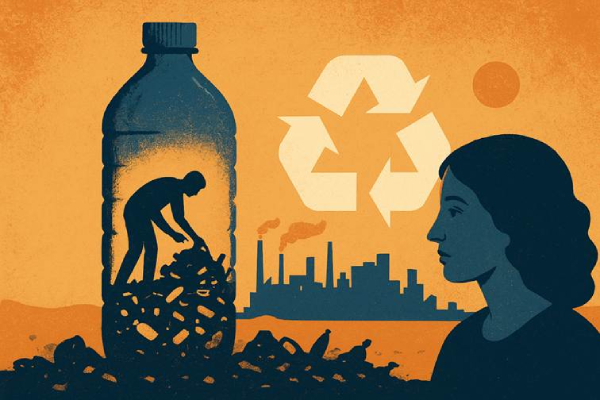
There is a comforting illusion often repeated in policy chambers and corporate boardrooms in India — that plastic is not inherently the problem; its mismanagement is.
It sounds reasonable, even scientific. The argument goes: if only we had better segregation, stronger municipal infrastructure, more efficient recycling plants, and more responsible citizens, plastic could remain a neutral material — an engineering marvel rather than a villain. That belief, however, is a dangerous half-truth. It diverts attention from the choices of production, design, material use, and consumption patterns that underlie plastic’s entire life cycle. The issue is not only that plastic is mismanaged; the deeper problem is that it was designed for one-use convenience and rapid disposal.
Plastic’s story begins not at the garbage bin but in the oil fields and petrochemical complexes. More than 99 percent of conventional plastic is derived from fossil fuels — crude oil and natural gas. Every bottle, wrapper, and micro-bead carries the carbon footprint of extraction, refining, polymerisation, and disposal. India now generates between four and nine million tonnes of plastic waste annually, but only 13 to 60 percent of it is ever recycled. The rest — nearly half by some estimates — is incinerated, dumped, or left mismanaged in open environments. In 2022–23, total plastic waste generation exceeded four million tonnes, rising sharply from just over three million tonnes in 2018–19.
To claim that “plastic is not bad” is to ignore its biological persistence. Unlike organic materials, plastic does not biodegrade in any meaningful timeframe — it fragments into microplastics and nanoplastics that infiltrate soil, rivers, oceans, and even human bodies. These invisible particles have been found in fish, salt, and drinking water, entering the food chain and altering ecosystems. In coastal regions of India, scientists have detected microplastic contamination in almost all major estuaries. Thus, the problem is not only where plastic ends up but how it continues to exist — invisibly, persistently, and harmfully.
Even recycling, often celebrated as the moral solution, has hard physical limits. Mechanical recycling degrades polymer quality, while multi-layered packaging and mixed plastics are nearly impossible to process with current infrastructure. Chemical recycling is expensive and energy-intensive. India’s recycling rates vary widely — from as low as 13 percent in some states to around 60 percent in others, such as Odisha. Yet even these figures rely heavily on the informal sector, which handles an estimated 60 to 70 percent of recyclables without formal recognition or safety protections.
Packaging alone accounts for nearly 59 percent of India’s total plastic consumption. This form of plastic, used in food, beverages, and consumer goods, is the hardest to recycle because it is lightweight, multilayered, and contaminated with residues. Blaming “mismanagement” while continuing to expand this category of single-use packaging is like blaming smoke without questioning the fire.
The social dimension of the crisis is equally stark. Who bears the cost of plastic’s convenience? It is the urban poor living near landfills, the waste pickers breathing toxic fumes, and the rural communities whose water bodies collect urban runoff. Plastic pollution is not an equal-opportunity disaster — it is distributed along lines of class, geography, and power. The informal recycling workforce prevents environmental collapse daily, yet remains unacknowledged in formal policy and unsupported in national budgets.
India’s circular economy mission has projected enormous opportunities: trillions in potential market value and millions of new jobs by 2050. But ambition alone cannot erase systemic contradictions. A truly circular economy is not just about looping materials; it is about redistributing responsibility. It demands that producers design for reuse, that regulators enforce extended producer responsibility, and that consumers shift from convenience to conscience. Without this ethical and cultural shift, circularity risks becoming a decorative slogan rather than a transformative framework.
Structural and scientific challenges remain. Urban-rural disparities, weak enforcement, and dependence on extractive industries undermine sustainability goals. Even advanced recovery technologies cannot compensate for relentless growth in single-use plastics. The data are clear: India’s material consumption has grown from 1.18 billion tonnes in 1970 to nearly 7 billion tonnes in 2020 and is projected to double again by 2030. If this trajectory continues, recycling alone cannot balance the scale of extraction and waste generation.
To say that plastic is not bad but only mismanaged is to excuse a design system that externalizes its costs onto nature and the poor. When production is measured in millions of tonnes, when recycling yields are barely a fraction, and when policies protect corporations more than waste workers, mismanagement is not an accident — it is a design flaw.
India’s circular future must be built on three principles: responsibility, recognition, and redesign. Responsibility means holding producers accountable for the full life cycle of their products. Recognition means valuing the invisible workforce that sustains recycling. Redesign means eliminating the root causes of waste — from material choice to consumer habit.
Plastic is not innocent. Mismanagement is not incidental. Both are symptoms of a deeper culture of disposability. Until India confronts that culture, every recycled bottle will carry a quiet echo of denial. The myth of innocent plastic will remain one of our most convenient lies — unless we choose to see, and act, beyond it.
The Poison of Plastic and the Illusion of Greenery
Original article at Counter Currents
Every year, humanity manufactures over 430 million tonnes of plastic, and nearly two-thirds of it is used only once before being discarded. Of this waste, around 12 million tonnes finds its way into the oceans annually, where it threatens over 700 marine species and destabilizes entire food chains. Scientists now estimate that each of us ingests approximately 20 grams of microplastics every month — the equivalent of a credit card — through air, water, and food. The boundary between nature and the human body has quietly dissolved; the environment has entered us.
Plastic is not merely a waste management issue — it is a chemical and ecological crisis. Born from fossil fuels, it carries within it the same carbon logic that drives climate change. When burned, plastic releases dioxins, furans, and PCBs — among the most toxic compounds known to science, linked to cancers, hormonal disruption, infertility, and developmental disorders. When buried, it does not decompose but breaks into microscopic fragments that infiltrate soil, groundwater, and eventually our crops. Researchers have found microplastics lodged in human lungs, bloodstreams, and even placentas. What we once threw away has come back to inhabit us.
Against this grim reality, the comforting image of tree plantations often emerges as a moral balm — a symbolic act of redemption. Trees, after all, stand for renewal and hope. A single mature tree can absorb about 22 kilograms of carbon dioxide per year and cool the surrounding air through transpiration. Yet no number of trees can neutralize the chemical persistence of plastic. Forests cannot absorb polyethylene; their roots cannot extract polymer particles from the soil. Even pristine mountain snow and deep-sea sediments now contain microplastics carried by the wind. The world’s greenery, it turns out, is being silently coated with plastic dust.
The faith in afforestation as an antidote to all ecological ills reveals a troubling simplification. Governments and corporations launch massive plantation drives, often as performative gestures — offsetting pollution through saplings while continuing unsustainable production. In India, millions of trees are planted each year, but according to the Central Pollution Control Board, only about 40% survive beyond five years, while plastic waste grows at nearly 8% annually. The arithmetic is unrelenting — you cannot plant your way out of a petrochemical crisis.
Plastic pollution has also become a human security challenge. It seeps into the most vulnerable layers of society: the informal waste economy, where women and children sort plastic waste barehanded; the flood-prone cities where clogged drains turn rainfall into urban disasters; and the coastal communities whose livelihoods depend on marine ecosystems now choked by plastic debris. The Global Environment Facility warns that unchecked plastic contamination could trigger new forms of displacement by 2040, as fisheries collapse and water resources turn toxic. In that sense, plastic is no longer just an environmental problem — it is a slow, invisible form of violence against human life.
The solution lies not in green symbolism but in systemic redesign. A genuine circular economy would reimagine how materials flow through society — designing for reuse, minimizing extraction, and valuing waste as a resource. Policy instruments like Extended Producer Responsibility (EPR) and bans on single-use plastics must be enforced with rigor, not rhetoric. Investments in biodegradable alternatives, decentralized waste segregation, and consumer awareness can together alter the toxic trajectory of convenience.
But beyond technology and policy lies a moral reckoning. Plastic has become the mirror of our civilization — cheap, durable, and disposable. Planting trees gives us the illusion of healing, but reducing plastic gives us the substance of change. One repairs what has been lost; the other prevents what we are yet to destroy. The future will not be determined by how many saplings we plant, but by how much waste we refuse to create.
Author
Ashish Singh has finished his Ph.D. coursework in political science from the NRU-HSE, Moscow, Russia. He has previously studied at Oslo Metropolitan University, Norway; and TISS, Mumbai.