
When I was a kid, there was a television commercial that included the line, “It’s Not Nice To Fool Mother Nature.”
I’m not here to advertise. I will not reveal the name of the company, which is not relevant to the information presented in this video except for the message about fooling Mother Nature. Not only is it not nice to fool Mother Nature, it’s also nearly impossible. When we believe we are fooling the natural world, we are generally fooling only ourselves.
An article posted at Futurism on 9 August 2025 is titled Robot Crab Meets Terrible Fate When Its True Nature Is Discovered by Real Crabs. The subtitled is a single word followed by an exclamation mark: “Wrecked.”
Here’s the lede: “Scientists apparently underestimated the aggression of itty-bitty male fiddler crabs when they deployed a friendly robot version during mating season.”
The following three paragraphs introduce the peer-reviewed paper while providing an overview of the article: “In a paper published in the [British] journal Proceedings of the Royal Society B, animal behavior researchers from the UK’s University of Exeter detailed the embarrassing end to their experiment with ‘Wavy Dave,’ a 3D-printed, Bluetooth-controlled crab-bot trained to wave at its fellow crustaceans.
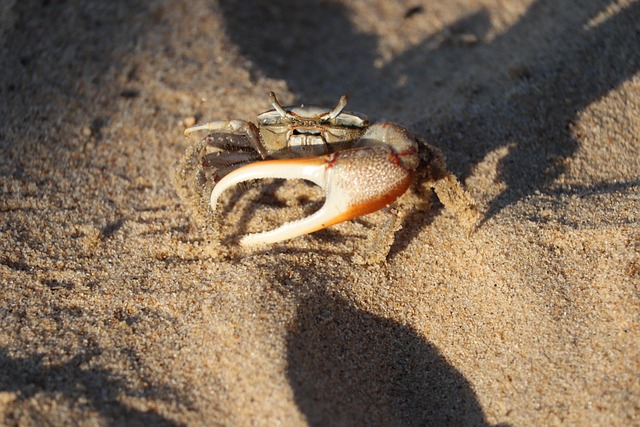
Known for having one claw that’s much larger than the other, fiddler crabs not only wave their large pincers to attract mates, but actually hold diminutive competitions during their mating seasons in which females choose those whose claws are biggest — yes, seriously — and wave the fastest.
Though scientists already knew that male fiddler crabs will, as [the] … lead study author said in a statement, ‘adjust their sexual displays if rivals are nearby,’ less was known about what exactly those males do in response to the rivals themselves.”
The large claw on fiddler crabs can account for more than 30% of the mass of the crab. It is a huge part of the relatively small animal.
To address the question of how male fiddler crabs will respond to rivals, the scholars took their robot to the mudflats of Portugal’s Ria Formosa Natural Park during the mating season of the crabs. To determine how male crabs respond to rivals, the scientists placed the robot crab, Wavy Dave, among other fiddler crabs during mating season.
As explained by the article at Futurism, the male fiddler crabs initially left Wavy Dave alone, possibly because his larger claw was bigger — and therefore more likely to win the attention of females or pose a threat — than their own. According to the first author of the peer-reviewed paper, “the females realized [the robot] was a bit odd.” This oddness caused some of the male fiddler crabs to confront Wavy Dave.
As explained in the Futurism article, Wavy Dave didn’t fare well. The robot had his dominant claw pulled off by a crab, thereby destroying the robot. The response from the first author of the peer-reviewed paper: “If you own a shop and your rivals start selling things really cheaply, you might have to change how you run your business. The same might be true for males signaling to attract females — and our study suggests males do indeed respond to competition.” The scholar went on to explain that male fiddler crabs has “subtle ways” of adjusting their actions “to compete in a dynamic environment, investing more in [sexual] signaling when it is likely to be most profitable.”
I turn now to the peer-reviewed, open-access paper in the Proceedings of the Royal Society B. Titled Biomimetic robots reveal flexible adjustment of sexual signaling in a wild invertebrate, the paper was created by six scholars and published on 6 August 2025. The Abstract tells the tale, as any good Abstract does: “Studies of communication in primates, birds and fish show that signalling behaviour is often flexibly adjusted depending on the presence, characteristics and behavioural states of others. Such flexibility is likely important in competitive social contexts such as sexual signalling, where attractiveness is directly affected by rival behaviour. Although sexual displays are often sensitive to the presence and proximity of rivals, less is known about the effect of changes in rival signalling. In this study, we used a biomimetic robot to manipulate rival morphology and waving behaviour in a wild population of fiddler crabs (Afruca tangeri) and investigated whether males responded flexibly by adjusting their own activity and waving. Males were less likely to enter their burrow when the robotic rival was waving, particularly if that rival had a small claw, and spent less time in their burrow if they did enter. While outside, males produced more waves when the robotic rival was waving fast, not by changing their own rate but by prolonging their bouts. These results reveal the subtle ways in which an invertebrate flexibly adjusts behaviour to remain competitive in a dynamic environment, investing more in signalling when it is likely most profitable.”
The Introduction relies on abundant, additional peer-reviewed evidence to provide the context for this research: “Signalling in a range of non-human animals is often highly flexible, in that its expression is adjusted depending on the presence, composition and even behavioural states of the receivers. These receivers can encompass intended recipients as well as passive bystanders and potential eavesdroppers. Examples of flexible signalling include various forms of gestural communication in non-human primates, birds and fish, as well as vocal communication in non-human primates, birds and anurans. In chimpanzees (Pan troglodytes), for instance, the targets of attacks modify the acoustic structure of their screams to exaggerate the threat only if at least one bystander matches or exceeds the dominance rank of their attacker. In fowl (Gallus gallus), subordinate males performing ‘tidbitting’ to advertise food discovery to nearby hens are less likely to produce audible vocalizations alongside their visual motor display if the alpha male is attentive (head up and not vocalizing), which reduces the speed and severity of the alpha male’s attacks. In these examples, the signaller flexibly adjusts its behaviour in a way that seems adaptive, by enhancing the potential benefits of signalling while reducing the potential costs.
Mating competition is one important area in which there is likely to be strong selection for flexibility in signal expression. The effectiveness of sexual displays varies depending on the presence and receptiveness of potential mates, as well as competition from rival signallers. …
Given that signallers often directly compete for a limited number of mating opportunities, we might expect individuals to adjust their own signalling behaviour in response to short-term changes in the signalling behaviour of nearby rivals, and for those rivals to do the same. For example, if potential mates prefer signallers displaying at high rates and one signaller increases the rate at which they are signalling, this changes the relative attractiveness of all nearby competitors, which may prompt tactical adjustments. Disentangling these inter-dependent responses requires careful experimental manipulation of signalling behaviour, for which biomimetic robotics are an increasingly powerful tool. In this study, we investigated tactical adjustment of sexual signalling behaviour in a wild population of the fiddler crab Afruca tangeri. We used a custom-built biomimetic robot to investigate experimentally how male crabs adjust their sexual signalling in response to fine-scale changes in the signalling behaviour of a rival male. We independently manipulated multiple aspects of the robot’s display and recorded how real A[fruca] tangeri males changed their own behaviour in response.
The bottom line comes in the final paragraph of the story at Futurism: “Like so many drunk bros in bar fights, the male fiddlers only attacked Wavy Dave after assessing the situation and getting feedback from the females — and ultimately, nobody lost except for the robot.”
Poor Wavy Dave. The robot, and the scholars involved in this research, found out that you don’t mess with Mother Nature. This is good advice that, had humans taken into account a few millennia ago, we might have been able to clean up our collective mess.
Author
"Dr. Guy McPherson is an internationally recognized speaker, award-winning scientist, and the world’s leading authority on abrupt climate change leading to near-term human extinction. He is professor emeritus at the University of Arizona, where he taught and conducted research for twenty years. His published works include 14 books and hundreds of scholarly articles. Dr. McPherson has been featured on TV and radio and in several documentary films. He is a blogger, cultural critic, and co-host of his own radio show “Nature Bats Last.” Dr. McPherson speaks to general audiences across the globe, and to scientists, students, educators, and not-for-profit and business leaders who seek their best available options when confronting Earth’s cataclysmic changes." source