
As I have indicated previously in this space, the world’s oceans store more than 90% of the heat humans generate.
In addition, these oceans absorb about a quarter of the carbon dioxide we produce. As a result, the oceans serve as buffers against anthropogenic climate change.
An 18 October 2025 story at BBC is titled Mystery heatwave warms Pacific Ocean to new record. Here’s the lede: “The waters of the north Pacific have had their warmest summer on record, according to BBC analysis of a mysterious marine heatwave that has confounded climate scientists.”
My first thought: Is this really a Mystery? After all, according to the designed-to-fail Intergovernmental Panel on Climate Change, we are amid the most abrupt climate event in planetary history. The IPCC reached this conclusion in its 8 October 2018 report, Global Warming of 1.5°. The IPCC report includes this line, backed by two peer-reviewed papers: “These global-level rates of human-driven change far exceed the rates of change driven by geophysical or biosphere forces that have altered the Earth System trajectory in the past (…); even abrupt geophysical events do not approach current rates of human-driven change.”
In other words, those of us paying attention have known for more than seven years that Earth is amid the most rapid event in planetary history. This event is underlain by collective human actions generating fossil fuels. As reported by the designed-to-fail IPCC, “even abrupt geophysical events do not approach current rates of human-driven change.”
The story at BBC explains with three short paragraphs: “The waters of the north Pacific have had their warmest summer on record, according to BBC analysis of a mysterious marine heatwave that has confounded climate scientists.
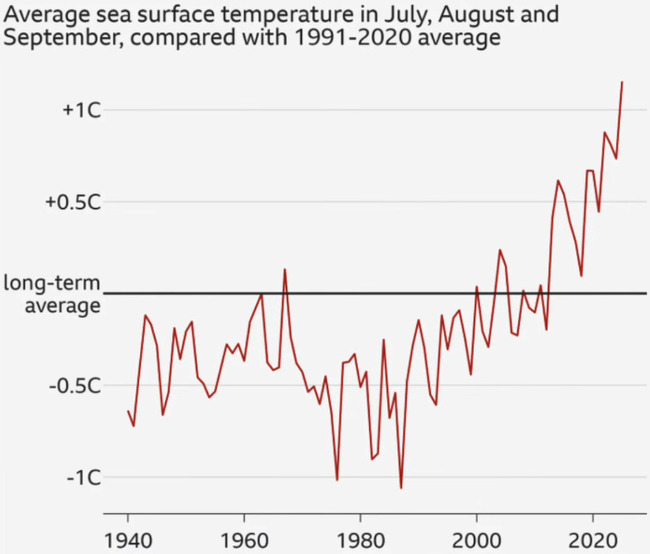
Sea surface temperatures between July and September were more than 0.25C above the previous high of 2022 - a big increase across an area roughly ten times the size of the Mediterranean.
While climate change is known to make marine heatwaves more likely, scientists are struggling to explain why the north Pacific has been so hot for so long.”
I have mentioned Zeke Hausfather previously in this space. Dr. Hausfather is a climate scientist at Berkeley Earth, a US-based research organization. He is quoted in the BBC story: “There’s definitely something unusual going on in the north Pacific.” He said such a rapid increase in temperatures across a region so large is “quite remarkable.”
The BBC conducted their own analysis. Using data from the European Copernicus climate service, the BBC calculated average temperatures between July and September within a large area of the northern Pacific Ocean. The area is sometimes called the “warm blob” because of its self-explanatory character. It has been used in previous research studies, including one focused on the aerosol masking effect. More about that peer-reviewed paper shortly.
The story at BBC continues with alarming information: “The figures show that not only has the region been warming quickly over the past couple of decades, but 2025 is markedly higher than recent years.” A figure in the article demonstrates the remarkable rise in temperature.
The following paragraph includes mention of another peer-reviewed paper: “That the seas are getting hotter is no surprise. Global warming, caused by humanity’s emissions of carbon dioxide and other gases, has already trebled the number of days of extreme heat in oceans globally, according to research published earlier this year.” The phrase, “research published earlier this year” includes an embedded link to a peer-reviewed paper in the renowned Proceedings of the National Academy of Sciences.
The article at BBC continues with four short paragraphs: “But temperatures have been even higher than most climate models – computer simulations taking into account humanity’s carbon emissions – had predicted.
Analysis of these models by the Berkeley Earth group suggests that sea temperatures observed across the north Pacific in August had less than a 1% chance of occurring in any single year.
Natural weather variability is thought to be part of the reason. This summer has seen weaker-than-usual winds, for example. That means more heat from the summer sunshine can stay in the sea surface, rather than being mixed with cooler waters below.
But this can only go so far in explaining the exceptional conditions, according to Dr Hausfather.”
Hausfather is quoted again: “It certainly is not just natural variability. There’s something else going on here as well.”
The BBC article continues with a mention of the aerosol masking effect: “One intriguing idea is that a recent change to shipping fuels might be contributing to the warming. Prior to 2020, dirty engine oil produced large amounts of sulphur dioxide, a gas harmful to human health.
But that sulphur also formed tiny, Sun-reflecting particles in the atmosphere, known as aerosols, which helped to keep a lid on rising temperatures.
So removing that cooling effect in shipping hotspots like the north Pacific could be revealing the full impact of human-caused warming.”
Further peer-reviewed research is embedded in the following paragraph and then explained: “Other research suggests that efforts to reduce air pollution in Chinese cities has played a role in warming the Pacific too.
That dirty air did a similar job to shipping in reflecting sunlight away, while cleaning it up could have had the unintended consequence of allowing more ocean heating.”
If you’re keeping score, that’s three peer-reviewed articles. I will mention them in the order they appeared in the BBC article. First, there is mention of the aerosol masking effect, which refers to a peer-reviewed, open-access article published 28 November 2018 in Atmospheric Chemistry and Physics. It was written by five scholars and titled Impacts on cloud radiative effects induced by coexisting aerosols converted from international shipping and maritime DMS emissions. It provides a relatively simple explanation of the aerosol masking effect in the Abstract that I will not include here.
The peer-reviewed, open-access paper in the Proceedings of the National Academy of Sciences was published 14 April 2025 and titled Global warming drives a threefold increase in persistence and 1 °C rise in intensity of marine heatwaves. Written by five scholars, the paper begins with a Significance subsection that provides an excellent description of the paper and its findings: “Marine heatwaves are periods of persistent warm ocean waters that are becoming more frequent and intense due to global warming, posing increasing threats to vulnerable marine ecosystems. Here, we calculate the relationship between increasing global surface air temperature and local sea surface temperatures to quantify the role of anthropogenic forcing in the intensity and persistence of these climatic extreme events. We construct a counterfactual climate of sea surface temperatures in which the long-term trends linked to global warming have been removed but that contains internal variability and preserves the observed chronology. The comparison between observed and counterfactual sea surface temperatures reveals the dominant contribution of anthropogenic forcing to observed marine heatwaves, especially since year 2000.”
The third and final peer-reviewed, open-access paper was published in Communications Earth & Environment on 14 July 2025. Prepared by 24 scholars, the article is titled East Asian aerosol cleanup has likely contributed to the recent acceleration in global warming. The Abstract is sufficient to make the relevant point: “Global surface warming has accelerated since around 2010, relative to the preceding half century. This has coincided with East Asian efforts to reduce air pollution through restricted atmospheric aerosol and precursor emissions. A direct link between the two has, however, not yet been established. Here we show, using a large set of simulations from eight Earth System Models, how a time-evolving 75% reduction in East Asian sulfate emissions partially unmasks greenhouse gas-driven warming and influences the spatial pattern of surface temperature change. We find a rapidly evolving global, annual mean warming of 0.07 ± 0.05 °C, sufficient to be a main driver of the uptick in global warming rate since 2010. We also find North-Pacific warming and a top-of-atmosphere radiative imbalance that are qualitatively consistent with recent observations. East Asian aerosol cleanup is thus likely a key contributor to recent global warming acceleration and to Pacific warming trends.”
It seems mention of the aerosol masking effect is becoming relatively common. This article from the renowned BBC includes mention of three peer-reviewed, open-access papers focused on aerosol masking. I appreciate this effort by the BBC and the authors of the peer-reviewed papers in bringing this story to light.
https://youtu.be/f0wJdLCULPQ?si=iE6qun5q0ZZhkvXO
Author
 Professor Guy R McPherson is an internationally recognized speaker, award-winning scientist, and the world’s leading authority on abrupt, irreversible climate change leading to near-term human extinction. You'll find many more of Dr. McPherson's articles in our Environmental Crisis section. He publishes on Substack, YouTube and at his original site NatureBatsLast, where you'll find his famous monster Climate Change Summary, an heroic meta-data analysis of peer-reviewed studies from the first two decades of this century. Follow our links for more information on aerosol masking, alternatively termed "global dimming". ~Ed.