

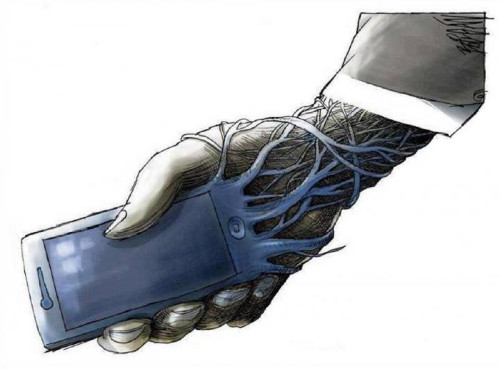
A study by Jeong Jin Yu, published May 2026 in the journal Science Direct,
"Problematic smartphone use and disengagement in first-year college students: A daily diary study of between- and within-person differences", reported that overuse of "smart" phones shows tendencies to alternate with days of social disengagement, which lead to more overuse or over reliance on "smart" phones, which leads to disengagement the following day. You get the picture:
With the expansion of information and communication technologies, problematic smartphone use (PSU) has become a salient concern, particularly among younger users (Barnes et al., 2019, Yang et al., 2020). Smartphones’ portability and constant connectivity support frequent, habitual engagement that, for some individuals, becomes excessive or difficult to regulate (Barnes et al., 2019, Kwon et al., 2013). In this study, PSU refers to device-level dysregulated smartphone engagement that can span multiple app categories (e.g., messaging, gaming, browsing, and notifications), rather than addiction to any single platform (Ahmed et al., 2025, Candussi et al., 2023, Kwon et al., 2013, Marino et al., 2021). PSU has been linked to adverse psychosocial and physiological outcomes, including poorer mental and physical health, strained interpersonal relationships, and lower academic performance (Candussi et al., 2023, Chen et al., 2025, Gingras et al., 2025, Ren et al., 2026, Yu, in press, Yu and Meng, 2024).
A second construct central to the present study is disengagement, a momentary state emphasized in boredom research. Disengagement is characterized by reduced involvement with one’s current task or environment and difficulty initiating or sustaining attention and effort toward personally meaningful activity, often accompanied by negative affect (Agrawal et al., 2022, Baratta and Spence, 2018, Eastwood et al., 2012, Elpidorou, 2018, Tam and Inzlicht, 2024). Disengagement is commonly conceptualized as a functional cue that current activity is misaligned with goals or insufficiently rewarding, which can motivate searching for alternatives (Baratta and Spence, 2018, Elpidorou, 2018). Longitudinal work links disengagement to maladaptive outcomes such as greater depressive symptoms and poorer adjustment (Bambrah et al., 2022, Spaeth et al., 2015).
The study was done with first-year college students in China. Before rather ubiquitous Western Sinophobia kicks in, note that these students have a lot invested, having recently taken the Gaokao, or National Higher Education Entrance Examination, to get into college in the first place.
You may have thought the SAT was too stressful, involved too much pressure, or was given too much weight in your college admissions process. But the SAT’s got nothing on the gao kao. China’s college entrance exam, properly known as the National Higher Education Entrance Examination, is the most grueling standardized test placed under the sweaty palms of teenagers in the world. Failure is not an option. Its takers do not know of these “weekends” of which you speak. Venture inside the horrifying world of college entrance exams in the Land of the Rising Sun, if you dare.
~ "15 Facts About China’s Grueling College Entrance Exam", CollegeStats.org,
These are students serious about their education. The addictive pull of "smart" phones has to be quite strong to entrap them in this negative feedback loop. In the US, we hear, "I've always got my phone with me" and "My whole life is on my phone!". Holding such sentiments regarding a device addictive by design would seem to indicate a vital need to separate our communication needs from our personal, emotional needs, finding ways of fulfilling all of them without giving the keys to our minds to corporations.