

Can renewables replace fossil fuels? The typical answer is “yes, but…” And when we come to discussing the “but,” things become emotional.
But there is nothing emotional in examining what a new technology can or cannot do. Renewables can do many things, but surely not exactly the same thing that fossil fuels could do up to now. Just as our society was built around what fossil fuels could do, the future society will be built around what renewables can do. It is a classic case of a good use of the TINA (there is no alternative) statement.Here you’ll find an assessment of the question by Mark Kelly. This post is interesting because it highlights the problem of “curtailment,” which is happening in countries that heavily rely on wind because of the lack of hydropower and low solar irradiation, such as Ireland.Basically, it is clear that renewables alone cannot support the same kind of wasteful and poorly organized society in which we live.
We need to start using renewables in a more creative way; we can avoid curtailment if we direct the surplus of energy into useful tasks to be started when energy is cheap and turned off when electricity is expensive. Say, fertilizer production, metal smelting, electrochemical processes, and the like. But this is an idea that’s completely alien to our current industrial system. We’ll have to learn how to move in a direction that has never been considered, so far. Along this line, a fundamental element will be the slowdown and the impending inversion of the growth of population, which will ease the strain on energy production. That’s described in my new book “The End of Population Growth” (Ugo Bardi)
Guest post by Mark Kelly
Jan 26, 2026
I set out to develop software that tackled 2 of the most common misconceptions regarding the energy transition
- Electricity and energy are one and the same
- We need to replace all our fossil energy with the same amount of energy from renewables
With the former, electricity is usually just 20% of a country’s energy. With the latter, electricity is much more efficient than fossil fuels - an internal combustion engine is 30% efficient, an EV is 90% efficient. A gas boiler is 90% efficient, but a heat pump is 300% efficient.
The software takes as input the energy use of a country in a year, figures out how much electricity is needed, and how many wind and solar units are required to provide that electricity. The assumptions are based on the current policy in Europe. Some are:
- All internal combustion engines (ICE) will be replaced with EVs
- Building heat demand will be greatly reduced as every building will undergo a deep retrofit and a heat pump fitting
- All diesel trains will be replaced with electric trains, again saving energy
- All diesel-powered ships will be replaced with hydrogen fuel cells (HFC)
- Storage will be provided by new pumped hydro
Now there are obviously many practical problems with this: replacing every ICE with an EV would require turning the Earth inside out, mining it for lithium, deep retrofit, and a heat pump costs about €70k in Ireland, HFC ships are probably unfeasible, and pumped hydro is expensive to build with limited sites. But anyway, I had to put my flag somewhere, and this is broadly in line with official energy transition policy.
For the energy use of a country in a year, I use ChatGPT Deep Research and ask it to output the results in the JSON format the app requires. I’ve added a few countries, the results of which are below.
How much of the clean electricity needed to fully replace fossil fuels is already being produced:
Australia: 17.5%
Brazil: 33.3%
Germany: 19.7%
Ireland: 20.8%
Nigeria: 4.4%
Norway: 69.5%
Spain: 31.7%
UK: 23.4%
US: 14.6%
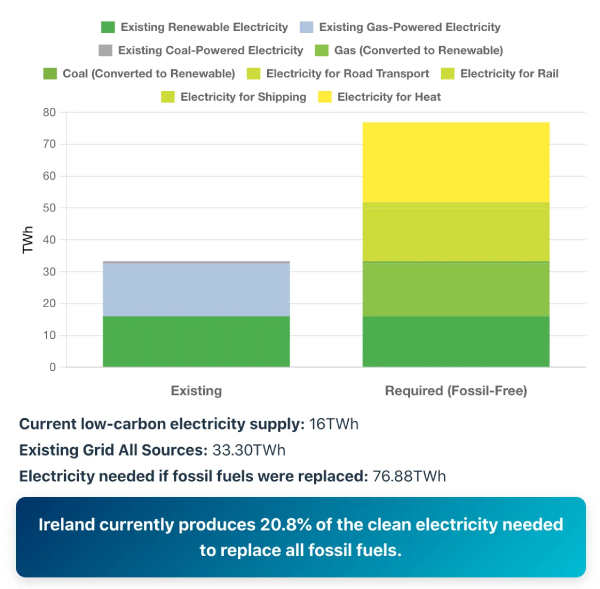
What we can see here is that hydro is king. The country with some of the world’s best hydro resources - Norway - is in a league of its own on 69.5%. Brazil and Spain, both with excellent hydro resources, are a third of the way to fully replacing fossil fuels. The non-hydro countries are all struggling. Most are between 20%-25%, and are probably close to the saturation point. Ireland, for example, hit its wind saturation point in 2019 - at about 20% of all energy. Other wind-dominated countries likely follow a similar pattern. See below the graph for Ireland.
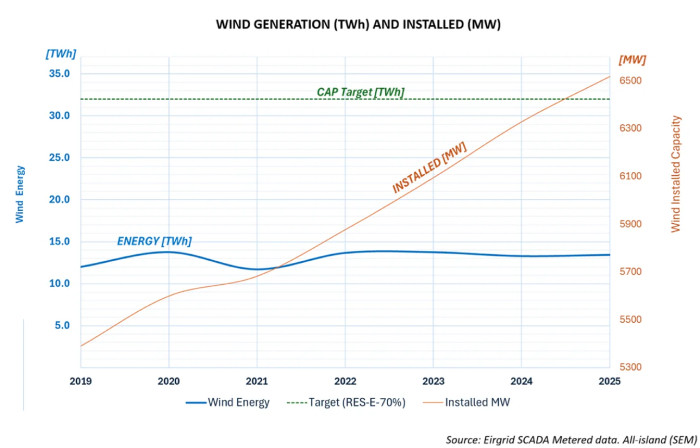
The non-hydro countries are probably going to land around 25%. Beyond that, adding more wind and solar delivers diminishing returns due to curtailment, intermittency, and grid constraints. Industry is likely going to move and concentrate around large hydro, just as it did at the beginning of the Industrial Revolution.
That means rather than adding more futile wind turbines, countries should move to downshifting fossil fuels by 75%, replacing it primarily through behavioural change rather than additional renewables. There was a recent example from Scotland that applied the Transition Engineering InTime framework to decarbonising the school run. Rather than swapping in EVs for ICEs, students were taught why car trips matter for climate change, leading to the students changing the rules of the school run themselves. Once walking and cycling became normalised again, car journeys fell by 33%.
A million other transition projects await.
The software can be used here: https://wind-and-solar.vercel.app/. It is open source, contributions welcome: https://github.com/Zander1983/WindAndSolar