
A clear-eyed look at why our inherited worldviews make decline unavoidable
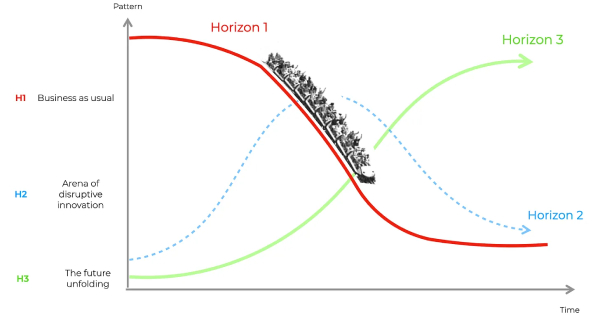
The Three Horizons model shows how the dominant system (Horizon 1) declines, disruptive innovations emerge (Horizon 2), and a new, life-aligned future takes shape (Horizon 3), gradually replacing what no longer serves.
We are in a collapsing curve in our civilizational moment: Horizon 1, the familiar world, is carrying us like a crowded roller coaster into decline. Horizon 2 disrupts with scattered flashes of innovation. And beneath it all, Horizon 3 rises — quiet, green, emergent — the future already unfolding, asking us to shift our allegiance from collapse to possibility.
Where We Left Off
In the The Architecture of Paradigms, Part I of this series, we explored the five paradigms and the archetypes they awaken — showing that each shift is not just intellectual but a quiet death of the self shaped by the old worldview.
But knowing how paradigms change is only half the story.
Part II turns outward — to the systems, constraints, and ecological realities that no belief can negotiate with. If Part I asked,
“Why is paradigm change psychologically hard?”
Here in Part II we ask:
“Why is paradigm change now unavoidable?”
This is not a descent into despair but into coherence, a clear look at why the first three paradigms — Conventional, Green, Sustainable — cannot carry us into the future.
Here begins the terrain where the comfort of story ends, and the clarity of reality begins.
1. Collapse Is the Result of Asking a Finite Planet to Feed an Infinite Story
For fifty years we tried to defy the most basic arithmetic in the universe:
Finite planet + Exponential growth = Eventual systemic breakdown.
This is not ideology.
This is not pessimism.
This is physics.
GDP must rise every year.
Corporate profits must increase.
Production must expand.
Consumption must accelerate.
Credit must grow.
Debt must outrun debt.
Every year, the economic system demands more energy, more materials, more throughput, more pressure.
But the planet does not expand.
The biosphere does not scale.
Living systems do not obey the logic of compound interest.
Growth on a finite substrate always ends the same way:
overshoot → depletion → collapse.
We are not the first civilization to discover this.
Only the first to globalize it.
Author
Ernesto Van Peborgh Regenerative Designer: Writer, filmmaker, Visionary entrepreneur, and thought leader. Founder of The Seva Institute and former Director of the Regenerative Economics Innovation Lab at the Capital Institute.