
In 2025, AI's rapid growth is revolutionizing industries, yet its environmental consequences and involvement in global conflicts are causing alarm.
This article examines how AI is changing everything from military tactics to the debate over art, questioning its ethical implications and the blurring of creativity with automation.
Disclaimer: No AI has been used in writing this article.
The year 2025 has witnessed an unprecedented surge of AI domination across all forms of media and platforms. From the arts industry to the arms industry, generative AI has officially taken over, and no one disputes the fact that it has become more than just a tool.
Artificial intelligence has been around for a while, but ChatGPT is not the same as it was when it was released following the COVID lockdown. The rapid growth of these tools caused massive awe and appreciation among many developers and corporations, who grappled to create their own versions, catapulting the term AI into a competitive field and a show of strength and prowess.
But this rapid evolution also calls for concern, particularly since this new global power mainly falls into the hands of harm more often than not.
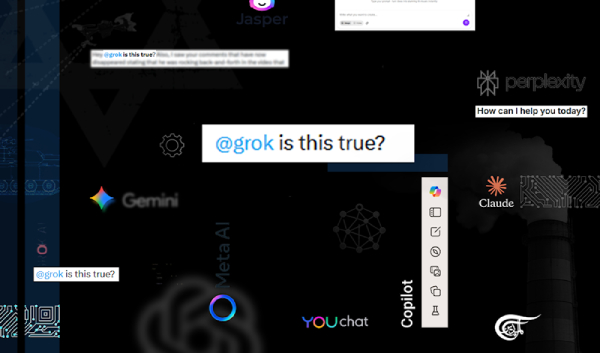
Mother nature, is this true?
The negative environmental impact of AI is and has always been on a steady climb. Even when it is being used to create solutions to save the environment, as in monitoring and bettering efficiencies in creating planet-friendly products, etc, it is still damaging the earth's structure.
In November 2025, the United Nations Environment Programme (UNEP), issued a note urging the research community "to develop and use scientific methods to allow the objective measurement of AI’s environmental footprint," as not enough studies have been conducted since there are no standardized methods for measuring or reporting or mitigating the environmental impact of AI nor yet even after several years since its outbreak, and that is mainly because of its rapid development. The note itself is a comprehensive assessment of what has been uncovered so far regarding the full AI lifecycle.
One of the environmental impacts of AI, categorized by the report, was on the level of direct impacts, which the UNEP explained to “include the consumption of energy, water and mineral resources, and the production of emissions and e-waste.”
Research shows that mining minerals and rare earth elements (REEs) has major environmental consequences, such as contamination of water and air, ecosystem degradation, and the release of greenhouse gases.
AI systems exhibit substantial energy consumption, with advanced architectures such as large language models (LLMs) contributing significantly to increased electricity demand. One study reports that a single LLM query consumes approximately 2.9 watt-hours of electricity, compared with 0.3 watt-hours for a simple internet search.
Even though there is limited scientific data on how much water AI uses, estimates suggest that AI-related water demand worldwide could reach 4.2–6.6 billion cubic metres by 2027, which would be more than half of the UK’s total water use in 2023.
As AI continues to grow, it is expected to produce increasing amounts of electronic waste. E-waste is already one of the fastest-growing types of waste globally, yet the contribution from data centres and AI chips remains uncertain. Overall, only about 22% of electronic waste is currently recycled or managed in an environmentally responsible way.
Future "data centers" of the world will be mostly reliant on AI, and considering how information accessibility shifts in favor of those who control these developments, there will be increased social inequality and bias, as already seen in how major companies manipulate decisions made by AI systems, spreading fake propaganda.
Thus, turning AI into a weapon.
AI at the forefront in modern warfare
Whether in the arms industry or security, AI is being integrated into military forces around the world, rewriting the rules of combat. Drones powered by AI are getting smarter on the battlefield, algorithms are being updated overnight; this is a new form of arms race. A more lethal one.
In military terms, AI is now the brain in arms. From autonomous to semi-autonomous systems to AI-driven Command and Control, quadcopter drones to ground robots, AI is not only now guiding the equipment, its also choosing its targets.
In Ukraine, for example, a main element in the warfare against Russia has been Nvidia's Jetson Orin, dubbed 'war brain.' Because of it's small size, they've been able to wedge the Orins in every quadcopter and unmanned ground vehicles. These same models have been seen in Israeli munitions and American swarming drones.
But not all AI battles are fought with gunfire.
AI’s number 1 beneficiary: 'Israel'
This year, on June 30, UN Special Rapporteur Francesca Albanese submitted a report to the UN Human Rights Council, which states that "Israel’s forever-occupation has become the ideal testing ground for arms manufacturers and Big Tech – providing significant supply and demand, little oversight, and zero accountability – while investors and private and public institutions profit freely."
The most prominent advancement of AI this year has been its military capabilities, and Big Tech companies have all been scrambling to test their new artificially intelligent murder weapons on occupied Palestinian land.
The report highlighted the role of digital occupation present in surveillance systems, biometric databases, and AI-based targeting. Big-name companies Amazon and Microsoft have both struck a $1.2 million deal with "Israel" to implement Project Nimbus, a cloud deal that supplies the Israeli Security Ministry with AI and data infrastructure, an infamous tool that aided Israeli military training in its war on Gaza.
This month, Nvidia’s CEO said they will build a multimillion-dollar "research and development campus" in "Israel". NVIDIA, dubbed a world leader in AI computing, develops high-end processors and networking chips essential for training AI models. It is confirmed that Nvidia’s work in “Israel” is the largest outside of the US.
Expected to be completed in 2027, this move will “position Israel at the core of AI solutions,” for this chip giant has helped advance “Israel’s” AI infrastructure in recent years, “including the deployment of its Israel-1 supercomputer.”
'Oracle stands with Israel'
American tech company founded in 1977 by Larry Ellison, Oracle, is a prominent leader in enterprise software, data management, cloud infrastructure, and AI. A proud Zionist, Ellison has been on a mission to silence pro-Palestinian voices and to control pro-Israeli media. The company itself has donated over a million dollars to the apartheid economy in previous years, and continues to do so, providing “Israel” with AI tech that is “deployed to facilitate grave human rights violations,” teaching the IOF how to use Oracle’s cloud for military purposes.
Trying to build a “pro-Israel information empire,” Ellison has been aiming this year to acquire an ownership stake in US TikTok in a deal engineered by President Donald Trump. The main purpose is to change the algorithm and structure of TikTok in the US to push pro-MAGA and pro-"Israel" messaging, with increased censorship and control to spread Zionist propaganda with the help of AI.
Mostly in the US, this new generation’s database is reliant on video-based information and AI research tools, and with Big Tech controlling the narrative of these tools, it is imperative to note that it’s going to be harder to find accurate and reliable intel.
AI surveillance spies: Palantir and Dataminr
Since October this year, US military personnel have been operating in a Civil-Military Coordination Center (CMMC) in occupied Palestine, 20km from Gaza, tasked to implement Trump’s “peace plan.”
Palantir and Dataminr, US surveillance firms, are involved with this CMMC. Maven, built by Palantir, has its own personnel sprawling the premises. Built as an AI platform, Maven “collects and analyses surveillance data taken from warzones to speed up US military operations, including lethal airstrikes. The platform sucks information from satellites, spy planes, drones, intercepted telecommunications, and the internet,” as reported by US defense outlets.
Also involved at the CMMC, Dataminr, an AI start-up, relies on strong ties with platforms like X to facilitate state and corporate surveillance of internet users. The company offers governments “the ability to surveil any social media user’s past digital activity and discover an individual’s interconnectivity and interactions with others on social media.”
Israeli control over Palestine remains firm, with the help of AI systems that offer the entity unlimited supervision over Palestinian lives. Disregard the military dominance; the never-ending threat is in the infrastructure of an AI industry that is using the outcomes of war and genocide for capital growth and authority.
This year's controversy: Is AI art?
No, as a matter of fact, it's not. This is a debate that has been going on for a while, and simply put, real art is created by real people. Actual art demands actual work; it is art because it requires creativity and effort. AI tools unabashedly allow users to steal artists' work to "mimic" their styles; merely copying someone else's work and writing a "prompt" does not make you an artist, and does not make that your "work". No matter how hard or "creative" writing a prompt is, it's not the same as creating. It is certainly not the same as using tools like Procreate or Photoshop.
Some argue that AI is a disability accessible art; there is nothing impressive about letting AI do the work rather than experimenting with different ways to create. People with disabilities overcome them by innovation, resorting to even higher levels of creative development. Art is about the story and meaning that inspires a person to create their piece; it is meant to be a medium of expression, not a tool for mass production. Art symbolizes human endurance, and AI cannot replicate that.
When asked about AI in October of this year, Guillermo del Toro, one of the world's most creative filmmakers, said he would "rather die" than use it in any of his future films. He said the mishandling of AI would lead to the world's worst features. Del Toro compared AI tech to the character in his movie, Frankenstein; “I did want it to have the arrogance of Victor [Frankenstein] be similar in some ways to the tech bros,” he said. “He’s kind of blind, creating something without considering the consequences, and I think we have to take a pause and consider where we’re going.”
Del Toro's Pinocchio, a stop-motion film, took him 15 years to complete. There is an inspiration in a journey like that. He regards stop-motion as a human-driven art form that resists automation. Another global artistic inspiration, Hayao Miyazaki, the creator of Studio Ghibli, is also famously known for taking exceptionally long periods of time to create an art piece. A 4-second scene in his movie The Wind Rises took his team 15 months to complete, entirely hand-drawn.
One might mock that in the age of digitalism, or even claim it is useless and a waste of their time, but AI cannot replicate the feeling the Ghibli team felt when the scene was finally finished. Miyazaki himself said every second was "worth it." This is what art is all about: the human spirit. Famous artists in history are all famous for certain pieces they created that carry within them a story of the artist's life.
So no, simply mimicking other people's work and claiming it is art is a fallacy. We are entering a point in life where hard work is mocked, and art is ridiculed. Be it music, film, gaming, or the writing industry, generative AI is turning media of expression into soulless slop.
We are allowing the arrogance of AI to seep into our lives and step over once sacred boundaries. Generating videos of people long deceased, making them do and say things they never did. Using a singer's voice on songs written poorly by AI, generating beats with no rhythm and calling it music, and plastering actors' faces in roles they've never been in. Let us not forget how recently, people are generating AI photos of themselves on Jeffrey Epstein's plane and thinking it's funny. The world is becoming desensitized, and AI thrives on it.
It is not about productivity and convenience. The purpose of art and creation isn't to sell a finished product; the value in creation is to fuel our curiosity and reflect who we are at the moment. AI is being sold as a productive tool in a capitalistic ideology, but artistic practice should put effort into it to have credibility.
You don't need a degree to be creative; you just need a pen and yourself.