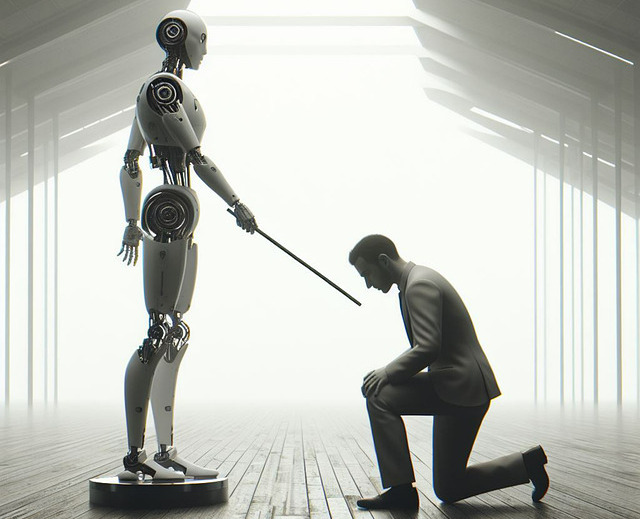
Decade-long moratorium on states' abilities to regulate AI's effects on their citizens portends a "free ride" for tech giants.
Remember 2015? In the decade 2015-2025, Ignitec cites these among their 10 major technological advances in the last decade:
- 5G, voice recognition, artificial intelligence, cloud computing, and the Internet of Things have changed how we communicate, manage our health, and consume content
- Electric vehicles, self-driving cars, and wearable technologies have significantly impacted public and personal safety and health
- What we produce, how we shop and pay for goods/services have been transformed by 3-D printing, augmented reality and blockchain technologies
Lots can happen in a decade, especially in technology, and that's how long states will be prevented from regulating AI, according to Trumps Big Beautiful Bill, the text of which you'll find below. Congress wants to give the tech giants the advantage of a free playing field with uniform regulations. What could go wrong?
Copyright, for one thing. For example, we at TitanicLifeboatAcademy.org work conscientiously to observe the US DMCA (Digital Millennium Copyright Act) and the EUCD (European Copyright Directive) as well as the Fair Use doctrine for nonprofits, preferring always to re-post materials licensed under Creative Commons  or Public Domain. But, AI doesn't care. AI crawlers vacuum sites for articles, graphs, pictures - everything. And, no credit is recorded or reproduced. You may ask AI for information about a topic, then you may write about the topic and you will not give credit for any material you're quoting because you don't know where it came from. So much for copyright. You may have a readership who pay a small monthly subscription for your content, but as AI grows, why bother to pay? Users can re-post your content without payment or even attribution if they get it from AI. Jon Reed at CNET writes "generative AI poses privacy, transparency and other risks for consumers that lawmakers have sought to temper."
At the international level, Reed notes the "economic implications are significant, as the US and China race to see which country's tech will predominate." For years, the US has sourced its rare earth elements from China, where the world's largest deposits lie. Why does this matter? According to the Center for Strategic and International Studies:
REEs are crucial for a range of defense technologies, including F-35 fighter jets, Virginia- and Columbia-class submarines, Tomahawk missiles, radar systems, Predator unmanned aerial vehicles, and the Joint Direct Attack Munition series of smart bombs. For example, the F-35 fighter jet contains over 900 pounds of REEs. An Arleigh Burke-class DDG-51 destroyer requires approximately 5,200 pounds, while a Virginia-class submarine uses around 9,200 pounds.
When one state is so dependent on another, particularly for important items, wouldn't it seem important to maintain friendly relations with that other state?
"In a world facing declining world hegemony, it can be argued that the US has been trying to create an enemy that could replace the USSR, namely China." Vanguard Think Tank, "Creation of an American Enemy". "This process began when China became the world’s second-largest economy and climaxed during the Trump administration. By creating the perception of China as a national enemy the United States has a justification to expand upon its imperialist interests in Asia and particularly in the South China Sea....While China’s influence has been undoubtedly growing within past years, it is pursuing a type of foreign policy which is very different from the imperialist tendencies of the United States and the Soviet Union....The most obvious example of Trump’s attempt to create a negative perception of China was during the Covid-19 Pandemic when Trump began to characterize the virus as the 'Chinese Virus' (Yam, 2020). By placing the blame on a foreign national enemy, Trump was able to shift the blame away from his administration from the economic repercussions of the pandemic. Trump’s use of China during Covid-19 is the perfect microcosm for justifying the Frankenstein theory, a state creating the perception of another state as the enemy so that it can justify its own actions to the public."
See "Another Failure of Imagination?" and The Telegraph's Daniel DePetris' "China is the enemy of the world and has nobody to blame but itself". Or, Senator Rick Scott's website June 26, 2025, "Sen. Rick Scott to U.S. Ambassador David Perdue: Communist China is our Enemy and Can’t Be Trusted. US Secretary of Homeland Security, Kristi Noem, "Let me be clear — China is our enemy. South Dakota is continuing to fight against communist China."
Hmmm. So, what will the US do? According to a Pew Research study, Americans are wary of AI. The AI moratorium is one piece of the answer: double-down. Lift all restrictions on AI development so billionaire tech entrepreneurs can increase their wealth and the US can catch up with China.
Of course, that gives China 10 years, too...
The proverbial "can of worms", for your reading pleasure, below, in full.
H.R. 1, SEC 43201. Artificial Intelligence And Information technology Modernization Initiative
https://www.congress.gov/bill/119th-congress/house-bill/1
Subtitle C--Communications
Part 2--Artificial Intelligence and Information Technology Modernization
(Sec. 43201) This section prohibits states and localities from limiting, restricting, or otherwise regulating artificial intelligence (AI) models, AI systems, or automated decision systems entered into interstate commerce for 10 years. This prohibition does not apply to any state law or regulation the primary purpose and effect of which is to remove legal impediments to, facilitate the deployment or operation of, or consolidate administrative procedures in a manner that facilitates the adoption of AI models, AI systems, or automated decision systems; that does not impose substantive design, performance, data-handling, documentation, civil liability, taxation, fee, or other requirements on AI models, AI systems, or automated decision systems, unless such requirements are imposed under federal law or are generally applicable to other models and systems that perform similar functions; that imposes only fees and bonds that are reasonable and cost-based and treat other models and systems that perform similar functions in the same manner as AI models, AI systems, and automated decision systems; or the violation of which carries a criminal penalty.
This section also provides specified funds to the Department of Commerce to modernize and secure federal information technology systems through the replacement of some existing systems and the deployment of commercial AI and automation technologies. Specifically, Commerce must use funds appropriated under this section to (1) replace or modernize legacy business systems with commercial AI and automated decision systems; (2) facilitate the adoption of AI models that increase efficiency and service delivery; and (3) improve the cybersecurity of federal information technology systems through modernized architecture, automated threat detection, and integrated AI solutions.
Under this section, AI is defined as a machine-based system that can, for a given set of human-defined objectives, make predictions, recommendations, or decisions influencing real or virtual environments. An AI model is a software component of an information system that implements AI technology and uses computational, statistical, or machine-learning techniques to produce outputs from a defined set of inputs. An AI system is any data system, hardware, tool, or utility that operates in whole or in part using AI. An automated decision system is any computational process derived from machine learning, statistical modeling, data analytics, or AI that issues a simplified output (e.g., a score, classification, or recommendation) to materially influence or replace human decision making.
The Transparency Coalition discusses the Bill's potential ramifications here, and there are more articles online.