
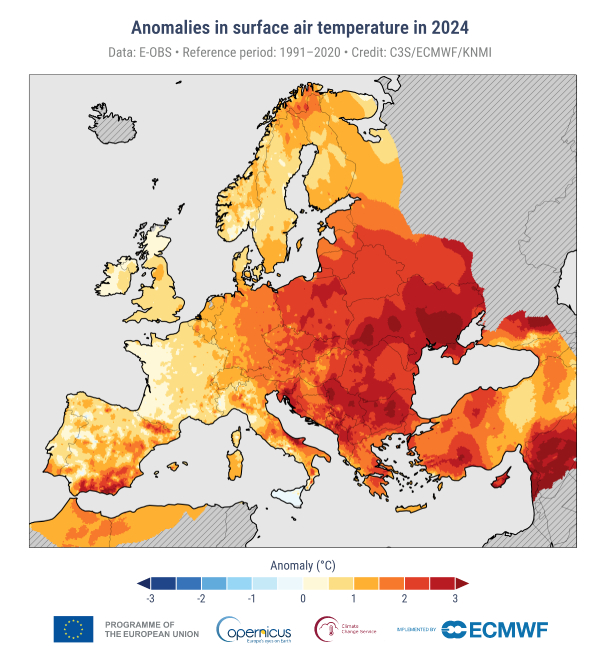
Globally, 2024 was the warmest year on record, following on from the remarkable warmth of 2023.
It became the first year with a global average temperature exceeding 1.5°C above the pre‑industrial level.2 The 1.5°C target of the Paris Agreement refers to the average temperature exceeding this threshold over a 20‑year period. The latest five‑year average temperature is 1.3°C. The last 10 years have been the warmest ten years on record.
Ocean temperatures were also exceptionally high in 2024, influenced by the residual effects of the strong El Niño that peaked in late 2023, and higher‑than‑average or record‑high temperatures in most ocean basins. The annual average sea surface temperature over the non‑polar ocean reached a record high, as did global ocean heat content. Ocean warming and accelerated loss of ice from glaciers and ice sheets contributed to rising sea levels, and the global average sea level reached a new record high in 2024.
Atmospheric concentrations of the greenhouse gases carbon dioxide and methane continued to increase. Since the 1980s, Europe has been warming twice as fast as the global average, making it the fastest‑warming continent on Earth. This is due to several factors, including the proportion of European land in the Arctic, which is the fastest‑warming region on Earth, changes in atmospheric circulation that favour more frequent summer heatwaves, and a reduction in aerosol emissions.
Heatwaves are becoming more frequent and severe, and southern Europe is seeing widespread droughts. Glaciers in all European regions continue to melt. Changes in the pattern of precipitation, including an increase in the intensity of the most extreme events, have been observed. This can lead to increased flooding and likely contributed to some of the most catastrophic events seen in 2024.
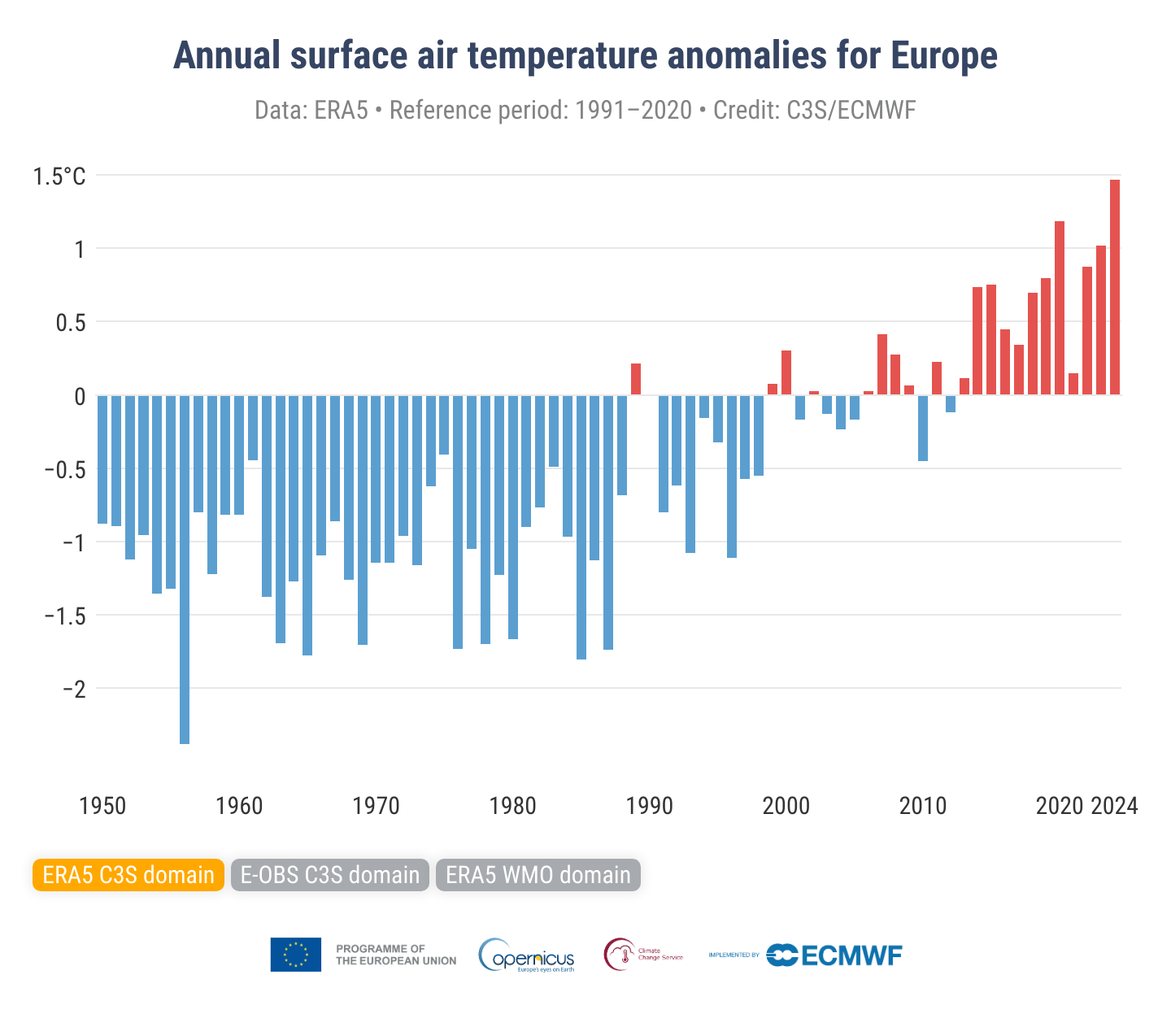
2024 was the warmest year on record for Europe, with record temperatures in central, eastern and southeastern regions. This is the #StateOfClimate.
— World Meteorological Organization (@WMO) April 15, 2025
Full #ESOTC2024 report: https://t.co/W9Wczjw9SP pic.twitter.com/CM0qR2zb34
Key messages
- Europe experienced its warmest year, with the second highest number of heat stress days and tropical nights, on record.
- The area of Europe experiencing days with temperatures below freezing is decreasing, with the year seeing the largest area on record with fewer than three months (90 days) of frost days.
- The number of ‘cold stress days’ was the lowest on record.
- For the European region and for the Mediterranean Sea, the annual sea surface temperature was the highest on record. It was also the warmest year on record for European lakes.
- Glaciers in Scandinavia and Svalbard saw their highest recorded annual rates of mass loss. They also saw the largest mass loss of any glacier region globally.
- Western Europe saw one of the ten wettest years on record and Europe experienced the most widespread flooding since 2013.
- The year saw a record proportion of electricity generation by renewables, at 45%.
The report is available online with interactive charts, a key events map, a summary with infographics, and a graphics gallery that also includes a range of additional figures and data download options: climate.copernicus.eu/ESOTC/2024
To cite this report:
Copernicus Climate Change Service (C3S) and World Meteorological Organization (WMO), 2025: European State of the Climate 2024, climate.copernicus.eu/ESOTC/2024, doi.org/10.24381/14j9s541
Author
World Meteorological Organization (WMO); Programme of the European Union; Copernicus Climate Change Service (C3S); European Centre for Medium-Range Weather Forecasts (ECMWF)