An article in TASS led me down a resources rabbit hole.
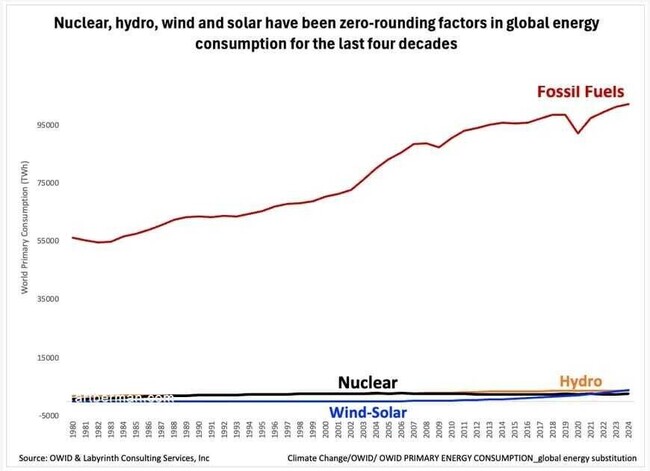
I like TASS because the articles are brief and directly to-the-point. "Global gas consumption gain 25 bln cubic meters in 2025" was no different. According to the article, global natural gas consumption increased by 100 billion cubic meters in 2024 climbing "to record-breaking 4.17 trillion cubic meters". It has increased another 25 billion in 2025.
It was that 4.17 trillion cubic meters that captured my attention. What does it mean? What percentage of the total remaining reserves does it represent? I decided to check Worldometer and found this:
Worldometer - Gas left in the world as of 2017
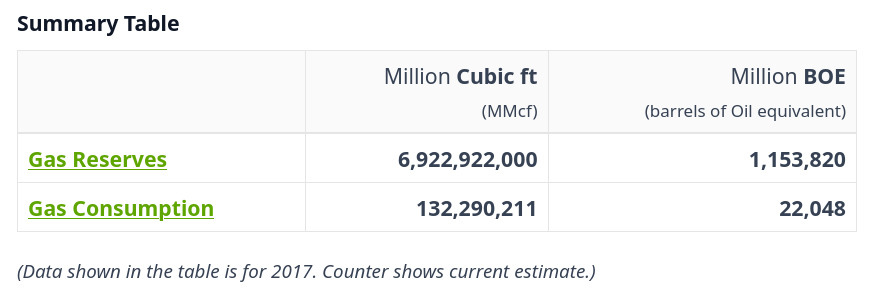
The counter at the top of that page read 1,056,988,089,727 BOE at 12:10:45 GMT on 12/23/25 when I first viewed it. Okay, but that's "barrels of oil equivalent" (BOE). This is a bit of an apples-and-oranges detour, but luckily the internet hosts converters like this one, which gives us 174,812,226,604,131cubic meters, bringing us back to two compatible numbers.

Dividing Worldometer's counter reading by TASS' 2024 global consumption rate of 4.17 trillion cubic meters per year, we get 174812226614131 / 4170000000000 = 41.92139726957577937649. Let's simplify that: 174.81 / 4.17 = 41.92 or, rounded, 42. Years. Repeat 42 years.
For me, that number stunned. In my prior reading, natural gas has usually been represented as sufficient to last over a century more, but that is apparently no longer true.
What about oil?
I began learning about Peak Oil in the early 2000s. Back then, the formula was simple: 80,000,000 bbl/d global consumption, 20,000,000 bbl/d of which was consumed by the US alone. An easy 4 to 1 ration of barrels of oil per day (bbl/d). Since I already had an open tab on Worldometer, I decided to check oil.
Worldometer - Oil left in the world as of 2016:
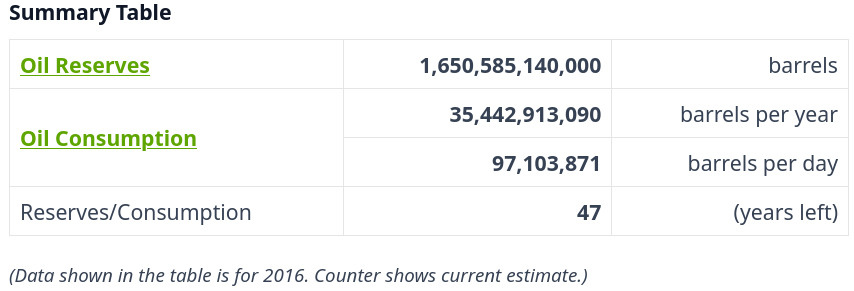
The Worldometer running counter on December 23, 2025, at 11:42:00 GMT read 1,312,335,230,765 barrels reserves. Dividing reserves by 98,000,000 bbl/d (a conservative estimate for consumption in 2025) showed 13,391 days.
13,391 days ÷ 365 = 36.687671233, or rounded to 36.7 or approximately 37 years.
2016, 47 years. The beginning of 2026, 37 years.
We have written many times on this site about Peak Oil, the point when a rapidly increasing decline in production begins. It's taken over 150 years to reach peak but will take far less time to reach "Game Over", as you can see.
You've no doubt heard or read recently that Venezuela hold the world's largest oil reserves. This wasn't always true:
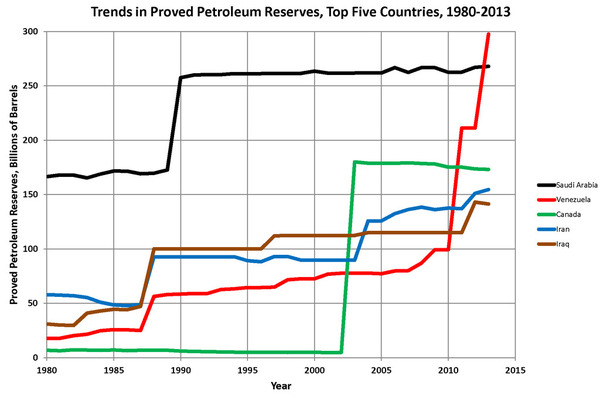
Definitions ("proven oil reserves") and ranking are set by the oil industry itself and affected by factors like production and exploration, as well as by depletion. And, because oil seems like a good excuse for invasion.
While recovery from increasing global climate disasters requires significant use of fossil fuels, a larger and most of us would say unnecessary consumption of fossil fuels is war, a very oil-intensive endeavor. Of course, not only does war consume extravagant amounts of oil, wars are fought over oil. "Both off the coast and beneath the occupied lands of Palestine, over 3 billion barrels of oil are estimated to exist, according to a 2019 U.N. report" reports Armos. As resources become more scarce, wars will be fought over the remains, further depleting the resources in attempts to control them.
In research, whether for this article or in general, I've rarely noticed the word, "conservation". Have you? Yet conservation, paring down, and repurposing increase resilience and sovereignty, and could have moved this point in history forward far into the future, thus protecting life. Still, each of us can practice conservation in our own life, teaching ourselves to live more simply, more mindfully, stretching our own resources and flexing our personal resilience. Sorting what we need from what we assume we need or want is both eye-opening and protective. George Carlin famously took on this concept in "Stuff". Conservation. Self-reliance. We have more power than we realize.
Something to think about.
Author
Caren Black, MA, MEd, Editor
Caren's professional career spanned over four decades in teaching, educational administration, small business consulting, children's musical theater, activism (for women, the Earth, and several nonprofits) and always, writing (education texts to newspaper articles to musicals - one with Anthony Newley as advisor) and research. She now writes at TEOLAWKI Times while raising chickens, ducks and sometimes awareness, including her own.